EssaysVolume5
Trade, Investment, and Payments
Richard A. Stanford
Furman University
Greenville, SC 29613
Copyright 2024 by Richard A. Stanford
stored, or transmitted by any means without written permission
of the author except for brief excerpts used in critical analyses
and reviews. Unauthorized reproduction of any part of this work
is illegal and is punishable under the copyright laws of the
United States of America.
CONTENTS
Introduction
1. The Dimensions of Global Commerce
2. The Theory of Trade
3. Barriers to Trade
4. Industrial Policy
5. The Multinationalization of Enterprise
6. Opportunities in Developing Economies
7. Government and International Commerce
8. External Balance
9. Exchange Rates
10. Payments Imbalances
11. Deficits and Surpluses
Return to START Menu
This essay set presents the theories of interregional trade and payments that underlie international commerce. Two recurring themes are that automatic adjustment mechanisms, if left alone, would alleviate trade and payments issues, and that politically inspired policies to affect trade and payments often disrupt the automatic adjustment mechanisms and prevent them from working.
The term "globalization" has come into wide-spread usage during the early years of the twenty-first century. The more commonly used terms prior to the present century were "international trade" and "international investment." It will be convenient to continue employing these terms to describe the global dimensions of commerce.
The theory of specialization according to comparative advantage is based upon interregional relationships. It abstracts completely from the international identities of the regions. However, the theory requires a highly abstract aggregate perspective that may appear to be unrelated to the microeconomic decision realities. In the following presentation, we shall lay out the theory of interregional trade and make connections to the decision realities where possible. Even though an aggregate perspective is required, the analysis employs various microeconomic concepts that must be generalized to the level of aggregate or industry behavior.
Isoquant Q14 (and its fellows in the map) is "well behaved" so that the technology which it illustrates is neither particularly capital nor labor intensive. By way of contrast, isoquant Q14 in panel (a) of Figure 2-1 illustrates a technology that is labor intensive relative to that illustrated by isoquant Q24 in panel (b). Along Q14 a relatively small decrement in the use of capital must be offset by a large increment in the use of labor in order to remain at the same level of output. Compared to Q14, Q24 in panel (b) illustrates a relatively more capital intensive technology because along Q24 a small decrement of labor requires a relatively larger increment of capital in order to remain at the same level of output. These factor intensity relationships are important to the subsequent argument that regional comparative advantages may be based (among other possibilities) in the choice of technology according to its relative factor intensity.
Along isoquant Q34 above point G the technology is relatively capital intensive, and capital is less substitutable for labor in the sense that if the labor input is decreased only slightly from L35 to L36, a large amount of additional capital (from K35 to K36) is required in order to remain at the same level of output. Along Q34 to the right of point H, the technology is relatively labor intensive, and labor is less substitutable for capital in the sense that if the capital input is decreased only slightly from K37 to K38, a larger amount of additional labor (from L37 to L38) is required in order to remain at the same level of output.
The isoquant map for industry A's production process is oriented toward the lower-left origin, 0A. The positive directions of change from origin 0A are as normally expected in bivariate graphic analysis. Because its isoquants are relatively steeply sloped, we can infer that item A is produced with a relatively capital intensive technology.
These quantity and cost considerations are then the bases for concluding that Inland has a comparative advantage in the production of item B while Outland has a comparative advantage in the production of item A. However, even if one of the regions, say Inland, had a cost or output advantage in the production of both goods relative to Outland, we could still designate Inland's and Outland's comparative advantages. Inland's comparative advantage lies with the industry possessing the greatest absolute advantage, while Outland's comparative advantage lies with its industry possessing the least absolute disadvantage.
The Inland society's iso-welfare map has been brought forward from panel (b) of Figure 2-3 to be situated in the box relative to Inland's origin in the lower left corner. The Outland society's iso-welfare map has been brought forward from panel (b) of Figure 2-4, rotated 180 degrees, and situated relative to Outland's origin in the upper-right of the box. The tangencies of Inland and Outland iso-welfare curves trace out the path from the Inland origin through points D, G, and E to the Outland origin. This path is usually referred to as a "contract curve" (not to be confused with the "maximum efficiency locus" in the production box diagram) because negotiation between the Inland and Outland societies can be expected to conclude with a contract for redistribution of A and B at some point along the path.
As can be seen in Figure 2-6, Inland generalizes both its production and consumption at point S' prior to the initiation of interregional trade with Outland. Once terms of trade negotiations are completed, Inland begins a process of increased production specialization in its comparative advantaged product, item A, by moving along its production possibilities curve from point S' to point T'. Inland then exports quantity (B2-B1) of its B output to Outland in exchange for an import of quantity (A3-A1) of A. Even though Inland has increased its specialization in the production of item B, through interregional trade it is able to generalize its consumption with the combination of B3 and A3, achieving iso-welfare level W4, which is a significant gain from trade relative to the welfare possibility (W3) in the absence of trade. It may be said that Inland has moved around its "trade triangle" from T' to V to Z, thus achieving a higher level of welfare by increasing specialization in its comparative advantaged product and trading off some of its additional production.
In Chapters 1 and 2 we made the case that specialization by comparative advantages together with free trade among regions can increase and ultimately maximize global welfare. This chapter examines the implications for welfare among trading partners if trade is encumbered by trade barriers. It is therefore necessary to shift our attention from interregional to international trade and assume the existence of governments that are both interested in and capable of imposing barriers to trade with other nations.
If the economy has been closed to international commerce, opening it to trade will make foreign-made products available to domestic consumers.
Or, a foreign-made supply of the product whose market conditions are represented in Figure 3-1 may become available in a second product life-cycle phase as production begins in so-called "imitator countries." Sw in Figure 3-2 depicts an initial small foreign (or "world") supply to a relatively large domestic economy. This small world supply is fairly inelastic with respect to price. Assuming that no trade barriers are imposed, the total supply available for consumption domestically is represented by the supply curve Sd + Sw, which is located in coordinate space as the horizontal summation of Sd and Sw.
Consequent upon the opening of trade to import of the foreign supply of the good, the domestic market price of the good falls from P1 to a new equilibrium at P2. At the lower price P2, the amount of domestic production falls from Q1 to Q2. The total quantity transacted in the domestic market increases from Q1 to Q3. Domestic producers are unhappy at the opening of foreign trade for import of the product; their sales revenue falls from the area of the rectangle represented by corner points 0Q1AP1 to the area of the rectangle identified by corner points 0Q2BP2. But consumers are happy that they can now purchase the larger Q3 quantity of the good at the lower price P2. Their consumer surplus increases by the amount of the triangular area m.
Once the tariff is imposed, the market price rises from P2 to P3. Domestic producers are all too happy to accept the higher price P3 although it is still not as high as the pre-trade price of P1. Domestic production increases from Q2 to Q4. At the higher market price, domestic consumption falls from Q3 to Q5, and domestic consumers of the product suffer a decrease of consumer surplus represented by the small triangular area below line segment FC. The quantity of the product imported decreases from (Q3 - Q2) to (Q5 - Q4). These effects are relatively small since the world supply Sw is fairly inelastic with respect to price, but the effects will become larger as Sw increases and becomes more elastic.
Domestic producers can be expected to appeal for protection. Domestic consumers should oppose any such protection measures on grounds that they will pay a higher price for the product, less of it will be available in the market, and their consumer surplus will shrink. Unfortunately, consumers typically are less well organized than producers who lobby for protection. In the Figure 3-4 illustration, the government could impose a tariff of any magnitude ranging from nearly zero to the full amount of the difference between P11 and P12. A tariff equal to this full difference would be sufficient to choke off all imports of the product. If the same tariff as illustrated in Figure 3-3 is imposed on the horizontal world supply curve in Figure 3-4, the tariffed supply curve will lie in position Sw + tariff, causing market price to rise to P13.
A quota is one type of "non-tariff barrier" (NTB) to trade. Other forms of NTB include performance, national origin, packaging, safety, and health requirements. If any NTB is imposed upon imports from a trading partner, the dimensions of the trade triangles in Figure 2-6 of Chapter 2 will be decreased. The result is that lower levels of welfare than those at point Z will be attained by both trading partners.
4. Industrial Policy A standard premise underlying the teaching of economic theory in "the West" is that markets are superior structures of economic organization for revealing and serving the preferences of populations. It is reputed to be superior for this purpose to fascism, communism, theocracy, imperial monarchy, and any other form of authoritarian governance that has been tried.
One of the tenets that follows from the economic premise is that governments should leave to market forces to discover comparative advantages and accordingly develop agricultural, mining, industrial, and commercial activity across regions. A complementary tenet is that global welfare will be maximized and populations that specialize in their comparative advantages discovered by markets can enjoy each others' fruits by trade with one another. Industrial Policy
A corollary conclusion is that political authorities (i.e., governments) should keep "hands off" of such specialization and trade processes. This means that they should not practice "industrial policy" to pick winners and suppress losers that do not correspond to comparative advantages. Interregional trade theory posits that failure to allow comparative advantage specialization will diminish the flow of trade and the economic welfares of prospective trading partners.
But industrial policy to attract the construction of plants has become standard procedure implemented by state and local governments in the United States in attempts to attract industry to their regions, irrespective of political affiliations of governors, mayors, and county administrators.
The comparative advantage principle is best understood with respect to what might be called the "natural" characteristics of a region, e.g., soil, terrain, location, labor, etc. It is not so clear that the principle applies to the fluidity of technological and industrial abilities that can be established by research and investment.
Two justifications for government intervention in regard to technological and industrial capabilities are to establish an advantage where none of the type previously existed, and to defend or preserve such an advantage in the face of foreign efforts to establish or pirate a similar advantage. Both the aggressive intent to establish a technological or industrial advantage and the defensive effort to prevent loss of such an advantage become matters of industrial policy.
Several exceptions to the admonition to specialize by comparative advantage are acknowledged in international trade textbooks, including the possibility that international political circumstances may override economic preferences. This has been the case in the twenty-first century as trading nations have imposed trade restraints and pursued their own policies to subsidize the local development of industries.
An international example of industrial policy accompanied by industrial espionage is that the Chinese government has sponsored the pirating of American technologies in order to enable the development of indigenous industries employing those technologies. China also threatens the technologies implemented in Tiawan to produce and export advanced silicon chips. This led the Biden administration to promote and subsidize the expansion of the domestic silicon chip industry.
Subsidized investment to promote development of an industry in one country may have the effect of altering what otherwise may have been natural comparative advantages between that country and its trading partners. A potential loss of comparative advantage to a trading partner that has implemented technological espionage and investment to capture the comparative advantage may be sufficient non-economic reason to implement a countering industrial policy. Such industrial policy in one country may be seen to justify an opposing industrial policy in another country in the effort to preserve its comparative advantage or neutralize an emerging foreign comparative advantage.
Comparative advantage to the contrary not-withstanding, a failure to implement industrial policy at critical junctures may result in loss of comparative advantage that leaves the nation with diminished employment, income generation, and production of goods deemed essential to national security. Import
Substitution Industrialization
In the post-World War II era, governments in a number of countries, many in
Latin America and East Asia, pursued a special case of industrial policy,
import-substitution industrialization (ISI). Their intents were to contravene
their natural comparative advantages or develop new or
latent comparative advantages. The usual vehicles of ISI policy implementation
were subsidies for domestic producers and tariffs on imported goods that
would compete with domestically produced goods, with the intent of reserving
the domestic market for exploitation by domestic companies. ISI development
policies of course reduced these countries' flows of trade, with deleterious
effects on the welfares of their citizens.
The motivations to
implement ISI policies have included the desire to achieve autarky, i.e.,
internal self-sufficiency in the production of all goods and services consumed
in the region, or to give selected domestic industries a chance to develop and
“grow up” to become internationally competitive. At various times Japan, China,
Russia, and some Latin American nations have adopted ISI development policies.
In response to the sanctions imposed recently by Western nations on Russia in regard
to its invasion of Ukrane, Russia has move toward attempting to achieve
autarky.
ISI development
policies failed almost universally, not only because they contravened the
comparative advantages possessed by those nations that implemented them, but
also because they induced more imports of raw materials, machinery, and
technology than the reduction of imports that were tariffed. In almost all
cases where ISI policies have been implemented, the rates of economic grown
diminished along with their volumes of trade.
While ISI policies
attempted artificially to broaden domestic entrepreneurial opportunities
at the expense of foreign firms, they also narrowed the range of consumer
choice to higher-cost domestic goods. In most countries where ISI policies
were attempted and failed, they have been succeeded by export-oriented investment
(EOI) policies that exploit the countries' natural comparative advantages. EOI
development policies also increased the volume of trade and stimulated
economic growth in the regions where they were implemented.
While regions of the world may have macro level comparative advantages, the operatives who have to discover and exploit those comparative advantages are micro level people who function as decision making agents of business firms. It should also be noted that business decision makers can attempt to change a region's comparative advantages through implementing technological change and capital investment. The acts of discovering, exploiting, and changing comparative advantages are essentially entrepreneurial in nature.
Developing Economy Terminology
The theory of comparative advantage, now nearly universally accepted
by economists, holds that nations ought to specialize their production
in the goods and services that they can produce at lowest opportunity costs
(i.e., their comparative advantages) in order to achieve global resource
allocation efficiency and welfare maximization.
External Balance refers to a
nation's trade, investment, and official reserves transactions with the rest of
the world. A nation with an absolutely closed economy, i.e., one that is perfectly
isolated from the rest of the world, would have no external transactions to
balance. The external balance for an open economy that enjoys substantial
private sector trade and investment discretion is indicated by its Balance of
Payments.
Balance of Payments (BoP) accounting, strictly speaking, is not part of the process of accounting for
National Income and Product, but BoP accounting information feeds into the NIPA process of compiling GDP. Table 8-1 has been
designed to illustrate the structure of the BoP accounts. Information for Table 8-1 was downloaded from the Bureau of Economic
Analysis website (http://www.bea.gov/international/), but the information has
been reorganized and reformatted to exhibit a structure that is more easily interpreted. A table with more recent BoP data is
presented in the Addendum to this chapter.
For purpose of conceptual analysis, a nation's BoP
presentation requires only three sections, a Current Account section, a Capital
Account section, and an Official Reserves section. Table 8-1 exhibits a fourth
section, Discrepancy, for reasons that will be indicated below.
The Composition of Imports and Exports
Payments Imbalances
Early in the twenty-first century, the line
is most commonly drawn below the Balance on Current Account (line D in Table
8-1). Abstracting from the Discrepancy line (i.e., assuming that the
Discrepancy line total is zero), the Current Account is in surplus or in
deficit depending upon whether the sum of the nation's imports, gifts by
citizens to foreigners, and incomes earned by foreigners in the nation (all of
which involve fund outflows) is greater or lesser than the sum of the nation's
exports, gifts by foreigners to citizens, and incomes earned by citizens
overseas (all of which involve fund inflows). True balance of a nation's
Current Account occurs only when these two sums are equal and the Discrepancy
line amount is zero.
Payments Imbalance Adjustment Mechanisms
Sustainability of Current Account Imbalances
B. Imports of goods and services and income payments
H. Capital-account balance
Net financial transactions
J. Statistical discrepancy
The increase in exports was led by industrial supplies and materials, primarily petroleum and products. The increase in imports was led by automotive vehicles, parts, and engines, primarily passenger cars and other parts and accessories. Partly offsetting this increase was a decrease in imports of nonmonetary gold.
An exchange rate is the price of one currency expressed in terms of another
currency. During part of the twentieth century, the exchange rates of many
countries' currencies were relatively stable during some periods, but more
volatile during other periods. What causes exchange rates to change, and how do
changing exchange rates affect macroeconomies?
In Figure 9-1, the demand for the domestic currency on the forex market varies
inversely with price, €/$, as its principal determinant. The demand for the
domestic currency derives from two sources, citizens of the nation and
foreigners. Citizens of the nation may demand their own currency on the
forex market if they have acquired foreign currencies in
trade, as earnings on investments, or as gifts. The foreign demand for the
domestic currency is equivalent to the foreign supply of the foreign currency.
Foreigners may supply their own currencies to purchase the nation's domestic
currency on the forex market in order to make gifts to citizens of the nation,
import goods and services from the nation, or invest in the nation.
Assuming that the supply of dollars does not change, the increased demand
for dollars on the forex market induces the price of
the dollar to rise. This means that the dollar appreciates relative to the
value of the euro, or the euro depreciates relative to the value of the dollar.
A change in any of the non-price determinants of demand in the opposite
directions to those specified above would decrease the forex
demand for dollars. Again, assuming that the supply of dollars does not change,
the demand decrease would induce the euro price of the dollar to fall. This
means that the dollar depreciates relative to the euro, or the euro appreciates
relative to the dollar.
These demand-supply principles allow the following generalizations about the
likely direction of change of an exchange rate. Each statement should be read
through twice, once with the word to the left of the slash in each pair, and a
second time with the word to the right of the slash in each pair. Careful
attention should be paid to the ceteris paribus conditions. If "other things" do not remain the same, the
conclusion of the generalization may not obtain.
As the world economy becomes progressively more open and economically
integrated,
the vehicles for macroeconomic adjustment to internationally-sourced
disturbances attain ever greater significance. Basically, there are
only three
macroeconomic adjustment vehicles: exchange rates, domestic prices
(including
interest rates), and domestic employment (and incomes). A progression
of
"if statements" identifies the relevant adjustment possibilities:
The Demand for Money and the Demand for Exchange
The possible causes of an emerging or growing Current Account
deficit of a
nation are the same items listed above that cause depreciation of its
domestic
currency. Three of the most prominent causes are domestic incomes
increasing at
a faster pace than foreign incomes, domestic inflation at a faster pace
than
foreign inflation rates, and domestic interest rates which are lower
than
foreign interest rates.
As
noted above, the central bank may passively allow the net effects on
the
domestic money supply to have the natural price and interest rate
effects, or
it may attempt to neutralize the impact on the domestic money supply
with
off-setting monetary actions in the open markets for financial
instruments in
the nation.
In this section we illustrate with graphic models some scenarios which,
starting
from an initial equilibrium, eventually result in balance of payments
deficits.
The appendix to this chapter explores scenarios culminating in balance
of
payments surpluses.
Monetarists suggest that the bond market is not the only place where
people
can rid themselves of excess money balances. They may do so by
increasing their
consumption spending relative to the flow of their incomes so as to
decrease
their saving. Panel (c) illustrates that when people increase their
consumption
spending the aggregate demand curve shifts right (increases) from AD to
AD’.
Other things remaining the same for aggregate supply, AS, the increased
spending will induce output (and income) to rise above Y1,
and the
price level to rise above P1 as illustrated in panel (c).
The
previous section described the implications of a Current Account deficit (or a
Capital Account surplus). This section describes the implications of a Current
Account surplus (i.e., a Capital Account deficit).
Can exchange rate flexibility insulate the domestic economy from
international
disturbances? Suppose that there has occurred an
externally-sourced (foreign) decrease of demand for domestically
produced
"things" (anything, including merchandise, services, financial
instruments, direct investments, etc.). If this decreased demand
impacts
primarily the current account (merchandise and services), the result is
a
decrease of exports (X). Panel (d) of Figure 10-2 illustrates the
resulting
decrease of the demand for dollars on the foreign exchange market to
purchase
such things, precipitating an incipient balance of payments (BoP) deficit and portending a depreciation of
the exchange
rate.
In either case illustrated in panels (d) or (dd),
net exports (X - M) decreases, causing a decrease of aggregate demand
illustrated as a leftward shift of the AD curve in panel (c). To the
extent
that AD decreases, real output (Y) falls and unemployment rises.
A nationalistic sort of policy emerged in the second half of the
nineteenth
century as many of the industrializing nations of Europe and North
America resolved
to eliminate volatility in the exchange rates among their currencies by
establishing metallic standards. While the United States flirted with
gold and
silver bimetallism, it along with most other nation states settled upon
gold as
standard by the end of the century. Subscription by a nation to the
Gold
Standard was accomplished by having some government exchange-control
authority,
usually the treasury or a state sponsored bank or central bank, to
maintain the
value of the currency in terms of gold at an established (by fiat)
ratio
between a unit of the currency and an ounce of gold.
After
World War II, representatives of the governments of the victorious
Allied
nations met in Bretton Woods, New
Hampshire, to
hammer out a new exchange rate regime. While it had become obvious that
the
Gold Standard was unworkable in a world of discretionary policy, there
was
lingering sentiment favoring a metallic monetary standard as a means of
minimizing exchange risk. The system devised at Bretton
Woods constituted the U.S. dollar as the central reserve currency and
gave U.S.
monetary authorities the responsibility to keep the value of the dollar
fixed
to gold at $35 per ounce. Other nations subscribing to the Bretton
Woods system would then stabilize their currency values to the dollar.
In this
way, the risks associated with varying exchange rates would be
eliminated, or
at least minimized.
From
the end of the Bretton Woods era in 1971
until the present,
the global exchange rate system has nominally been one of flexible or
floating
exchange rates. However, governments, singly or in small ad hoc
groupings
(e.g., the Group of 7), have entered foreign exchange markets in
efforts to
manipulate one or another exchange rate. Sometimes the objective has
been to
arrest the decline or rise of an exchange rate. Occasionally it has
been to try
to push an exchange rate in a desired direction.
Managers of firms engaged in international commerce should monitor exchange
rate changes and likely governmental responses in regard to them. In countries that are suffering Current
Account deficits when exchange rates are permitted to flex, the ensuing
depreciation of the domestic currency will make domestically produced goods
less expensive to foreigners, and foreign goods will become more expensive to
citizens of the country. If
export-oriented domestic producers let the currency depreciation feed through
to their export goods prices, they can enjoy expanding sales. If they maintain their export goods prices in
order to widen their profit margins, their export sales may remain stagnant or
even decrease. The higher prices of
imported goods will cause domestic importers to suffer declining sales unless
they can offset the higher prices of foreign-made imports by cutting delivery
costs or accepting narrower profit margins.
During the 1980s and '90s it was fashionable in the media and in economics
texts as well to describe the U.S. trade deficit and the U.S. federal
government's budget deficit as the "Twin Deficits," and to
hypothesize the latter to be the cause of the former. At the turn of the
millennium, the U.S. government's budget deficits shrank to the point that
budget surpluses appeared possible, with forecasts of cumulative surpluses over
the next couple of decades sufficient to retire the entire federal public debt
of more than $4 trillion. However, early twenty-first century decreases in tax
revenues and increases of government spending caused the prospect of budget
surpluses to evaporate and deficits to become chronic and growing. By 2011, the
U.S. government's annual deficit had exceeded $4 trillion, and the cumulative
public debt was almost $15 trillion, nearly as large as the U.S. GDP. Since the trade and the budget deficits were reputed to be twins, one might
suppose that as the government's budget turned toward surplus around the turn
of the century the trade deficit might also have declined or become a surplus,
but this supposition would be wrong. Each month in the new millennium
seemed to bring a new trade deficit records (the U.S. trade deficit widened to
a record $69.86 billion in August, 2006) and the government's budget relapsed
into deficit as well, thus seeming to reconfirm the twin relationship between
the budget deficit and the trade deficit. With vague allusions about
causation, the media hardly knew how to handle the reporting of these
matters. And apparently economists were not
giving the media reporters much help in explaining the persistent and growing
trade deficit. There's still something missing from the deficits equation that
needs to be brought into the discussion. Perhaps the most straight-forward approach to explaining these matters lies
with macro theory income and expenditure concepts. From these concepts
we can deduce that the output of a nation (Y) is the sum of its personal
consumption expenditures (C), its gross private domestic investment
expenditures (I), its government purchases (G), and its exports (X) less its
imports (M), i.e., (1) C + I + G + X -
M = Y, In following discussion, we will use the convention of representing the
trade balance as (X - M) if it is a surplus, or as - (M - X) if it is a
deficit. Also from national income accounting principles we can specify that the
income (Y) generated in producing the national output can be used for
consumption spending (C), saving (S), and paying taxes (T), or (2) Y =
C + S + T. Since Y is common to both equations, we may set the left side of equation
(1) equal to the right side of equation (2), (3) C + I + G + X - M = C + S + T. The two Cs cancel each other. With substitution of
- (M - X) for the trade balance and rearranging terms, the relationship
becomes (4) (I - S)
+ (G - T) - (M - X) = 0, or (4') (I - S)
+ (G - T) = (M - X). Assuming that the value of the first variable exceeds the value of the
second variable in each set of parentheses, the three terms in parentheses can
be interpreted as a domestic saving deficit (I - S), a budget deficit (G - T),
and a trade deficit (M - X). The saving deficit, (I - S), alternately can be regarded as an
"investment surplus." The larger the
investment surplus the better because investment is the vehicle for
implementing new technologies, adding to the capital stock, and generally
enhancing the productivity of the labor force. But (I - S) also
has a negative implication when domestic saving is inadequate to finance all of
the investment that is being undertaken. Additional investment financing
sources are needed. The sense of equation (4') is that a combination of a saving deficit and a
budget deficit must equal (or be financed by) a trade deficit.
Alternately, a trade deficit enables either or both of a saving deficit and a
budget deficit. As long as the saving deficit is trivial in magnitude,
then it follows that the trade deficit must be approximately equal to the
budget deficit. While it is not clear that either is dominant and the
other accommodative, a seemingly safe presumption is that the U.S. government's
post-World War II budget deficits resulted from the political process, and that
the trade deficits emerged to finance the budget deficits. In any case,
during the 1980s the two deficits appeared to be twins, with a change in budget
deficit eliciting a same-direction (though not necessarily simultaneous) change
in the trade deficit. During the late 1990s, the U.S. government's budgetary deficits shrank with
on-going economic growth (often described in the media as a "torrid
pace" that exceeded 7 percent per annum during some quarters toward the
end of the decade). By 1999, the U.S. government's budget approached the
realm of surplus. A budget surplus may be represented as - (T - G), so
that equation (4') may be rearranged as (5) (I - S) - (T - G) = (M - X) or (5') (I - S)
= (M - X) + (T - G). This equation suggests that a saving deficit could be financed by the sum of
the trade deficit and the emerging budget surplus. During the late-1990s
the trade balance and the budget balance appeared no longer to behave as twins.
As the twentieth century wore on to its conclusion, the saving deficits
ceased to be trivial. During the last couple of decades of the twentieth
century, U.S. gross private domestic investment has grown faster than has
domestic saving as officially measured. The official measure of saving is
disposable personal income (DPI) less consumption spending (C). This measure
ignores saving in the form of wealth accumulation and saving after the fact of
consumption spending in the form of debt amortization payments. Early in
the twenty-first century, the measured U.S. saving rate approached an historic
low (negative during some quarters) even as investment boomed. The growing
saving deficits have been accompanied by federal government budget deficits of
varying magnitudes. The two together require a commensurate trade deficit
to finance them. Around the turn of the third millennium the deficits became
triplets. The dominating factor of the late 1990s in the U.S. appeared to be a communications
and computing revolution of force similar to that of the Industrial Revolution
in late nineteenth-century England. The salient economic feature of this
"New Industrial Revolution" was an ever-growing U.S. saving deficit
that has had to be financed by a combination of a growing trade deficit and/or
an increasing government budget surplus. The late '90s declining budget
deficits were produced by an increase in tax revenues as both the personal and
corporate income tax bases increased with the "torrid pace" of U.S.
economic growth. Supply-side restructuring of the U.S. economy during the
1980s also may have been an enabling condition to the unfolding of the
"New Industrial Revolution" of the 1990s. Declining budget deficits during the late 1990s decreased the government's
demand for loanable funds in the U.S. The
potential for budget surpluses at the turn of the century began to decrease the
demand for loanable funds as the government required
smaller amounts from the capital markets. The decreasing deficits of the
late 1990s might have been expected to decrease U.S. interest rates.
However, soon after the turn of the new century the U.S. central bank (the
Federal Reserve) resolved to increase nominal interest rates in an effort to
slow the pace of growth of the U.S. economy to a "sustainable level"
and avert inflationary pressures. A by-product of the Federal Reserve's actions to increase nominal U.S.
interest rates is that they have become higher than comparable rates in Europe
and the Pacific Basin, and this relationship has induced a flow of funds into
the U.S. in search of higher returns. The inflow of funds has increased
the demand for dollars and the supplies of other currencies on the foreign
exchange markets, thereby causing the dollar to appreciate relative to other
currencies. In addition, the administration continued to indulge in
rhetoric favoring a "strong dollar policy." By 2005 there was growing
concern in some quarters that the dollar had become overvalued. The dollar
appreciation made American goods appear more expensive to foreigners, with a
consequence of declining U.S. exports. At the same time, the stronger
dollar made foreign goods look cheaper to Americans, thereby causing U.S.
imports to increase. The combination of the tighter monetary policy and
the dollar appreciation has resulted in growing trade deficits that have served
to finance both the growing saving and government budget deficits. And then the U.S. economy suffered the so-called Great Recession that began in
2008. Macropolicy stimulus programs swelled the government?s budget deficits and accordingly increased
the public debt to historic levels. As the recession ensued, business
investment collapsed, reducing the saving deficit. The U.S. economy?s
trade deficits began to ameliorate as the U.S. income level fell, but continued
to help finance the government?s growing budget
deficits. It may be obvious how a government budget surplus could help to finance a
saving deficit, particularly when the surplus is used to retire public debt,
but how can a trade deficit help to finance a saving deficit? In order to
explain this, it would be a convenience to interpret the trade balance as the
Current Account in the nation's Balance of Payments. The nation's Balance
of Payments is comprised of three sections, the Current Account, the Capital
Account, and the Official Settlements Account. The Current Account is
comprised of three subsections: the Trade Balance, Net Unilateral
Transfers (i.e., the net of gifts by citizens of the nation to foreigners less
foreign gifts to citizens of the nation), and Net Income Earned Abroad (i.e.,
the net of income earned abroad by citizens of the nation less income earned in
the nation by foreigners). Since net transfers and net income earned
abroad are of relatively minor magnitudes and tend to offset each other in the
U.S. economy, the trade balance, (X - M) or - (M - X), accounts for the bulk of
the U.S. Current Account. We shall thus ignore net transfers and net income
earned abroad so as to treat the Current Account balance solely as the trade
balance. In a fixed exchange rate system such as the pre-Depression Gold Standard or
the post World War II Bretton Woods System, flows of
gold or international reserves were necessary to keep the exchange rates of the
subscriber nations' currencies unchanged vis-à-vis gold or other
currencies. A byproduct of the process of fixing exchange rates was that
the Current Account and the Capital Account balances for a nation could differ
in amount totals, with the difference being made up in the Official Settlements
Account. Since the early 1970s, the world has been on a nominal flexible
exchange rate system, though one in which governments of nations occasionally
attempt to manipulate exchange rates. If exchange rates were completely free to vary in response to market forces,
the Official Settlements Account total for each nation would be zero because
exchange rates would change to bring about an equivalence of the Current Account
total with the Capital Account total, or vice versa. A Current Account
deficit must be offset by a Capital Account surplus, and vice versa. If a
nation imports more from the rest of the world than it exports to the rest of
the world, the nation must export the ownership of enough capital to "pay
for" the trade deficit. In fact, the U.S. has experienced trade
deficits through most of the years beyond the early seventies when flexible
exchange rates became a reality. The Current Account deficits necessarily
have been offset by Capital Account surpluses. A Capital Account surplus may be comprised of a combination of long term
capital exports (e.g., foreign purchases of stocks, bonds, and real assets in
the U.S.) and exports of short term instruments (e.g., increased foreign
ownership of U.S. bank account balances and other liquid financial
obligations). The Capital Account balance must be the negative of the
Current Account balance when exchange rates are flexible. It is in this
sense that a Current Account deficit (most of which is composed of the trade
deficit) can help to finance a saving deficit. The corresponding Capital
Account surplus involves a net export of the ownership of capital, which is the
same as to say an inflow of funds from abroad. A trade deficit (a Capital
Account surplus) is thus a natural concomitant of a saving deficit, and is
necessary to help (along with a government budget surplus) with the financing
of the saving deficit. A saving deficit can be financed by a combination of budget surplus and
trade deficit. But if the budget is also in deficit, there is an even
greater burden on the trade deficit to finance both the saving deficit and the
budget deficit. How is this "financing" of the saving and budget
deficits brought about by a trade deficit? Market economies contain within
themselves adjustment forces that are invoked when prices or incomes are too
high or too low for equilibrium. These forces of adjustment are the unmet
intentions of market participants. Prices are the primary adjusters of
the market economy, but if prices change too slowly or are fixed or manipulated
by government authority, income (and correspondingly output and employment)
will become the shock absorbers of the market economy. Two prices that play crucial roles in the macroadjustment
of the market economy are interest rates and exchange rates. Interest
rates vary in response to changes in the demand for and supply of loanable funds, and the interest
rate changes elicit equilibrating changes in saving, investment, output, and
employment. However, if interest rates are fixed or manipulated by
government authority, excess demand or supply in the loanable
funds market will persist. The natural and inherent forces within the
economy will be prevented from bringing the trade balance (X- M) into
equivalence with the saving (I - S) and government
budget (G - T) balances. Much the same can be said for exchange rates because they are no less than
the prices of the nation's currency expressed as quantities of other currencies
for which it can be exchanged. Exchange rates vary in response to changes
in the demand and supply of the nation's currency on foreign exchange
markets. Currency demand and supply changes are invoked by changes in
income levels, price levels, and interest rates among nations. Exchange
rate changes are the crucial vehicles of adjustment of the trade balance to the
saving balance and the government's budget balance. Changes in either the
saving balance or the budget balance will initiate changing demand or supply
for the nation's currency, and thereby elicit exchange rate changes that ensure
equilibrating (and offsetting) changes in the Current Account and the Capital
Account of the nation's balance of payments. If exchange rates are fixed
or adversely manipulated by government authority, excess demand or supply of
the nation's currency will persist, and the Current and Capital Accounts will
not be brought into balance with each other or with the saving and budget
balances. We can offer several comments on the prospects for stability of the U.S.
economy during the early years of the twenty-first century. 1. At the turn of the third millennium, the U.S. government budget
surpluses did not become large enough to provide significant financing of the
growing U.S. saving deficit. The burden of financing the increasing
saving deficit thus still falls principally upon the trade deficit and is
aggravated by the persistent government budget deficits.[1] Early twenty-first
century tax cuts and expenditure increases appear to have eliminated the
possibility of budget surpluses and the retirement of public debt. Even
though the tax cuts may have given the population some more disposable income,
it appears that the saving rate has not increased relative to the investment
rate so as to diminish the saving deficit. Indeed, the national saving rate has
continued to fall as the economy has weathered the so-called "Great Recession"
that ensued in late 2008. The political issue has become whether to let the
2002 tax cuts lapse, which would amount to a tax increase as the economy
continues to suffer recessionary conditions. 2. The "New Industrial Revolution" boom came to an end by
the turn of the third millennium, but the U.S. growth rate was sustained
moderately well until the start of the "Great Recession" in
2008. After an actual decline in GDP during 2009, weak growth resumed in
spite of massive monetary policy injections of liquidity into the U.S. economy.
Persistent unemployment and stagnant or falling incomes have resulted in
declining trade deficits as imports have decreased. 3. A rising tide of protectionism in the U. S. has elicited demands
for new or higher tariffs, new or more stringent import quotas, and other
non-tariff barriers that might force a decline of the trade deficit. The
regrettable side effect of this protectionism would be to force a diminishment
of the saving deficit (due to a decrease of investment spending) that propelled
the "New Industrial Revolution" boom unless the government's budget
can be brought into surplus (which seems highly unlikely). 4. The U.S. government acting solo or in concert with a group of other
nations (e.g., the G8 or some other number of cooperating nations) may resolve
to prevent further appreciation or precipitate depreciation of the U.S. dollar
relative to other currencies. The dollar has experienced moderate
depreciation during the "Great Recession,” and
the dollar depreciation has stimulated U.S. exports and constrained U.S.
imports to cause the trade deficits to decrease. The U.S. government has urged
appreciation of other currencies (particularly, the Chinese yuan)
in the interest of promoting U.S. exports and constraining its imports.
With rising government budget deficits, future growth of the U.S. economy
continues at risk unless the U.S. saving rate can somehow be increased to
finance continuing domestic investment. 5. If the Federal Reserve is given responsibility for forcing further
depreciation of the dollar, it can do so only by sacrificing domestic monetary
policy to the achievement of the exchange rate goal. The foreign
currencies can be purchased only with monetary expansion that inevitably will
elicit global inflation as a byproduct of the forced dollar depreciation.
With recent monetary expansion, U.S. interest rates have fallen to historic
lows, inducing an outflow of funds in search of higher yields abroad. For
better or worse, the dollar has edged ever closer to becoming a global common
currency even as the dollar depreciates. If the saving rate cannot be increased so as to diminish the saving deficit,
the trade deficit might be diminished by sustained and accelerating growth
(another "New Industrial Revolution"?) that yields governmental
budget surpluses that can help to finance the saving deficit. However, by late
2008, the U.S. economy had entered the "Great Recession" and budget
deficits increased. By 2010 the cumulative public debt eclipsed $1 trillion,
but trade deficits were diminishing. With persisting U.S. government budget deficits and governmental
manipulation of interest rates and exchange rates, the economy's automatic
adjustment mechanisms may not be able to bring about either a falling U.S.
saving deficit or a declining U.S. trade deficit. If not, the triple deficits
will persist into the foreseeable future and are likely to aggravate
imbalances. [1] If the budget surpluses had continued to mount and the U.S. public debt had diminished, the trade deficits might have declined as the burden of financing the saving deficit shifted toward the budget surplus. A budget surplus thus could have played a positive role in substituting public saving (forced by taxation) for inadequate private saving, and if the public saving were returned to the loanable funds market in the form of public debt retirement.
<>
Our survey of global commerce begins with a half-serious apology for including a discussion of the international dimensions of business. The reason for the apology is that in much of the rest of the world outside of the United States of America, there is little significant distinction between international and domestic business operations. If one is in business at all, he or she automatically engages in international business operations. Managers of such firms hardly give second thoughts to the requisites for sourcing supplies, selling products, or locating production in countries other than that within which the firm's home office is located.
The apology is only half serious because many people in various countries, and notably the United States of America, are somewhat intimidated by the international dimension. It is a mixed blessing to the United States that it has a rich endowment of natural resources and a huge internal economy. Domestic firms have been able to rely upon the internal economy for both sources of supply and markets for their domestically-produced products. Because they have been able to look inward for over two centuries, managers of American firms have tended to regard the outside world as marginal or peripheral to their activities. Many view the international sector as possessing some mystique that requires special capabilities to penetrate. This perception is enhanced by the fact that Americans are for the most part monolingual. Although English is the only language spoken and understood by the majority of Americans, Spanish may yet overtake English as the American lingua franca.
The Increasing Importance of International Commerce
If much of American business has seemed intimidated by international involvements, post-war American consumers have carried on a love affair with foreign-made goods and services. During much of the post World War II era, U.S. balance of payments deficits have been the rule rather than the exception. Concerns about on-going trade deficits and mounting international debt to foreigners have led various U.S. governmental agencies to devise programs to promote exports and discourage imports. American experience with protecting domestic industries from foreign commercial incursions spans more than two centuries.
On-going trade and payments deficits and official concern about them have aroused the interest of the American academic community in international commercial relations. Beginning in the 1970s, a deliberate effort was mounted by business studies programs to internationalize their curricula. The most commonly used models for such internationalization efforts have been to employ foreign faculty and recruit foreign students, to introduce new courses focusing upon international business problems and procedures (e.g., international marketing, international finance, international management), and to infuse international concepts into existing courses as appropriate. The latter two models have spawned a flock of new textbook titles as well as revisions of existing texts to incorporate references to the international arena.
In a sense, the recent obsession of American commerce and academia with anything international is only a transitional phase. With the passage of time, international commercial activity will become more commonplace; eventually business studies curricula will become sufficiently internationalized that special commentary about the international sector will no longer be warranted. Three phenomena militate in favor of this transition. (1) Technological advances in communications and transportation shorten the time and costs of distance, thereby diminishing market imperfections and facilitating international exchange. (2) English, the language spoken by the majority of Americans, seems to have emerged as the global language of commerce as well. (3) Efforts underway in various regions of the world to achieve both economic and political integration (the European Union, a "single market" by 1993, currency union by 1999, and a "United States of Europe" by some point in the twenty-first century) tend to render concepts of the international ever less significant. But until such transformation is completed (if ever), we shall be compelled to include chapters such as this in our texts.
Bases for Interregional Commerce
John Donne has said that "No man is an island, entire of itself..." (Devotions upon Emergent Occasions, Meditation 17). It is surely true that no nation can be an island completely unto itself either. Some have tried. After both its Revolutionary War and World War I, the United States seemed to withdraw into isolationism in order to avoid further international entanglements, both political and commercial. After its establishment in 1918, the Union of Soviet Socialist Republics (U.S.S.R.) pursued a de facto strategy of autarky, i.e., internal self-sufficiency. Of all of the nations in the world, these two might have come closest to functional autarky because of the immense richness of their natural resource endowments. But neither of these nor any other nation in the world has been able to achieve absolute autarky. There are several fundamental reasons why they have found it either necessary or beneficial to engage in international commercial relations.
In recognition that the so-called "pure theory of trade" abstracts completely from references to nation states, we need to make a transition from the language of "international trade" to that of "interregional trade."
It is a fact of physical nature that resources are unequally distributed across the earth's geographic space. Some resources approach ubiquity (found everywhere); others are concentrated by regions. Resources that are found in only one or two places on earth may be referred to as geographic uniquities. Examples include rare elements or precious gems or metals, agricultural commodities that grow only under very special conditions, and natural tourist attractions. Populations of regions possessing such uniquities are fortunate in having access to such resources which they are able to exploit; populations elsewhere are correspondingly unfortunate. Populations of regions devoid of such uniquities may acquire them (or things produced using them) by engaging in interregional trade or military aggression to capture them.
There are few perfect ubiquities or uniquities among productive resources. Most resources are found in many places across the globe, although in greater or lesser geographic concentrations. Goods and services requiring those resources as inputs may be produced more cheaply in regions where they are found in abundance than in other regions where they are scarce.
The Principle of Comparative Advantage
Economists have enunciated the so-called principle of comparative advantage to explain regional specialization in the production of goods and services. According to this principle, people in each region should specialize in producing those goods and services that can be produced most efficiently in their region compared to other regions. "Most efficiently" means at least opportunity cost (in terms of other goods and services foregone) compared to the other regions. Since the production of goods becomes geographically specialized, people in different regions must trade their specialties for the specialties of people in other regions.
Generalization in consumption is enabled everywhere through trade even though there is regional specialization in production. It can be shown with theoretical exercises as well as empirical information that those who specialize their production according to the principle of comparative advantage and trade with one another enjoy higher welfare than they would under conditions of autarky.
It is sometimes suggested that there are regions of the world that are essentially devoid of productive advantages, whereas other regions seem to possess all of the advantages (veritable "Gardens of Eden"). We can resolve this problem by further refining the definition of comparative advantage. A region's absolute advantages include all of those things that it can produce at lower opportunity costs than can be achieved in other regions. A region's absolute disadvantage is anything that can be produced elsewhere at lower costs in terms of other goods and services which must be foregone.
It may well be that opportunity costs of most things are lower in one region relative to all others, but this does not mean that the region should generalize in production. Its comparative advantages lie in those things for which it has greatest absolute advantage(s), while the comparative advantages of other regions lie in the things for which they have least absolute disadvantages. They should still specialize in production, but the one in its greatest absolute advantage and all the rest in their least absolute disadvantages. It follows logically from this definition of comparative advantage that it is not possible for a region to have no comparative advantage(s). Furthermore, it can be shown that all of the regions of the world, the sparsely-endowed as well as the abundantly endowed, will enjoy higher welfare with specialization according to the principle of comparative advantage and trade with one another unencumbered by politically imposed constraints.
Modern elaborations of the theory of comparative advantage recognize at least five bases for regional comparative advantages: resource endowments, cultural preferences, known technologies, scale economies, and company-specific knowledge. The first three are endogenous to locale; the last two technically are independent of geography, but may become location specific at the discretion of production decision makers.
For purpose of illustration, it is usual in trade theory to hypothesize a two-resource, two-commodity, two-region world. Suppose one of the regions, A, is abundantly endowed with capital resources but has only enough labor to operate its capital stock, and that the other region, B, is abundantly endowed with labor but has a small amount of capital that serves as minimal tools for the labor. The two regions produce two commodities, X which under technologies known in both regions requires a great deal of labor but not much capital, and Y which uses substantial amounts of capital but only a little labor. If the two regions employ identical technologies for producing the two goods and further have identical preference functions, region A should specialize in producing good Y, whereas region B should produce more of good X. Each should trade some of its specialty to the other in exchange for some of the other's specialty.
Suppose that the two regions have identical resource endowments and know the same productive technologies. While people in both regions consume both goods, suppose that people in region A have a stronger preference for X, the labor intensive good, while people in region B like Y, the capital intensive good. In this case, it would be appropriate for region A to specialize in producing X and region B in producing Y. Each should trade some of its output to the other in order to achieve consumption generalization in both regions. In this case, the basis for comparative advantage is differential preferences rather than resource endowments.
As a third possibility, suppose that the two regions possess identical resource endowments and share a common preference system, but that scientists and engineers in region A have advanced technology with respect to the production of X so as to economize on labor, whereas common technology continues to be used in the production of Y, the capital intensive good, in both countries. Again, intuition suggests that region A should specialize in the production of X leaving region B to specialize in production of Y. They should trade some of their respective specialties to each other. The basis of comparative advantage here is differential technologies rather than resource endowments or preferences.
It would be highly unlikely in any of these cases that perfect specialization (i.e., only X is produced in A and only Y is produced in B) would result. Both goods would continue to be produced in both regions, but in each region more of the comparative advantaged good would be produced, and less of the comparative disadvantaged good(s). Also, the real world is composed of many regions, some of which are similar to others in respect to resource endowments, preferences, or technologies, and different from the other regions in various respects. The basis for comparative advantage of each may lie in one of these areas or a combination of them. Empirical evidence suggests that a larger volume of the world's trade is conducted among regions that are similar in income levels and preferences, than among regions that are widely divergent in any of these areas.
Qualifications to the Principle of Comparative Advantage
Managerial opportunities and threats are to be found in almost any circumstances, including those of interregional trade. We must note certain qualifications to the argument presented to this point. One is that comparative advantages, whether attributable to resource endowments, preferences, or technologies, are not "struck in stone," i.e., they are changeable. Circumstances of resource depletion can terminate a former comparative advantage based on the richness of a resource endowment. The discovery of a new deposit or pool of a natural resource can confer a comparative advantage. Population growth or immigration may confer a comparative advantage in producing labor intensive goods where one formerly did not exist. By the same token, emigration may result in depletion of a former comparative advantage based on labor abundance. Natural disasters such as a volcanic eruption, a hurricane, or a freeze that destroys a crop stock may bring to an end some historic comparative advantage. Changing preferences away from "old" goods and toward newly developed ones may shift comparative advantage from regions specializing in the "old" and toward regions specializing in the "new."
The forms of comparative advantage transition noted above follow from natural or market phenomena that are not under the control of the firm. One of the most significant forms of change in comparative advantages comes about through technological advances that develop new items or new processes that economize on scarce resources. Another significant phenomenon which may change comparative advantage is capital investment. Regions that formerly were capital scarce may become capital abundant, as for example the newly industrialized countries ("NICs") of South Asia. The reason that these two forms of comparative advantage transition are significant to managerial decision making is that they are implemented at the discretion of managers of firms. It is by mounting an effort at research and development (R&D) or by capital investment that managerial decision makers may seize entrepreneurial opportunities and deliberately change the competitiveness of their firms and the comparative advantages of their regions.
The International Dimension
To this point we have been discussing interregional trade; in the so-called "pure theory of trade" (the subject matter of Chapter 2) there is no distinction between interregional and international trade. The emergence of national identity and the nation state over the past four centuries have enabled two additional factors which provide for regional differentiation: nationalism and the operations of government.
The interests of governments in international commerce have necessitated another qualification to the comparative advantage theory. The government may attempt to protect an old domestic industry in order to preserve a comparative advantage that is fleeing to foreign regions. The government may attempt to neutralize another region's comparative advantage, or it may take "compensatory" action to offset some policy being implemented by the government of another region. In any of these cases of protection, the effect will be to diminish any potential for gain by comparative advantage specialization. Governmental roles in regard to international trade are further elaborated in Chapter 4.
National identity leads to nationalism, a sort of emotional cement that binds together people of the same cultural background. They may share a common history and heritage; they may be more-or-less homogeneous with respect to race and ethnicity; typically they subscribe to the same religion or various sects or denominations of a common religion; the vast majority of them speak the same language; and, most importantly, they share a common vision about what it means to be a citizen of the nation. The term is often used to describe a "nation of people" or simply "a people" in the biblical sense (the "Children of Israel" in the Bible are an example of a nation in this sense). The emotional cement of nationalism may reveal itself in the form of patriotism, i.e., love of homeland, its cultural and political heritage, its flag.
Other terms such as provincialism or regionalism may attain almost the same sense of nationalism, but with respect to the attitudes of people in more restricted geographic locales. Belgians typically are much more nationalistic with respect to being Flemish or Walonian than they are about being Belgian. It is more important to some in the United States to be Texans or Southerners than it is to be American. The European Union is attempting to establish a sort of super-national regionalism so that citizens of the fifteen member states will begin to feel a sense of European nationalism that eventually may displace nation-state nationalism. Although there is no good term to describe it, a similar emotional cement often exists among the students and alumni of an American state university, especially when in athletic competition with a rival state university.
Nation states are political entities defined by boundaries encompassing areas that may coincide closely with that populated by a "nation of people" in the biblical sense. Sometimes a nation state encompasses two or more nations of peoples. American Indian tribes have often been referred to as "nations;" there were many nationalities in the former Soviet Union; modern India encompasses numerous tribal peoples. In the early 1990s, the various nationalities contained by both the Soviet Union and Yugoslavia began to pull apart.
Occasionally political boundaries separating nation states divide peoples of the same nationality. The post-war political division of Europe left the German people separated by "walls" as well as borders. In South Asia, the Bengali tribal people are split by the India-Bangla Desh border. The Pakistan-Afghanistan border divides the Baluchi people, while the Pakistan-India border separates Punjabi tribal people. Separatist movements in these and other areas may have as their goal the reunification of peoples of the same nationality that have been separated by political boundaries.
Nation states also may not coincide with economic regions that are characterized by the possession of natural resources. Both the United States of America and the Russian Republic include numerous uniquely definable economic regions. Sometimes national boundaries split a common resource endowment region. Europeans have often redrawn national boundaries across the rich coal and iron deposits of the Alsace-Lorraine region.
The essential characteristic of the nation state is its possession and exercise of national sovereignty by the government of the nation state. "National sovereignty" means that the government of the state has the authority and the power to do anything it wishes with respect to the peoples and resources contained within its political boundaries. This power includes the ability to determine the form of economic organization of the economy of the state (until recently, the government of the former U.S.S.R. mandated socialism), and to impose protectionist measures with respect to the industries within the economy (the government of the U.S.A. has a long history of protectionism). It includes the right to insist upon the use of a national currency within the realm and to exclude the of currencies preferred by others. Sometimes this authority and power leads to human rights abuses to which people and authorities in other nation states raise objections. Such exercise of discretion by the state is constrained only by the tolerance of its citizens and by attitudes and military prowess of other nation states.
Currency Diversity
One of the most critical factors that sets international trade apart from interregional trade is a consequence of the exercise of national sovereignty: the use of different currencies in different nation states. Because the dollar in used in the U.S. economy while the pound sterling is accepted exclusively in the United Kingdom, the balance of payments between the U.S. and the U.K. is important to economic and political considerations in both countries. The dollar-sterling exchange rate is critical to the volume of goods and services entering into international commerce between the two countries at any point in time.
Where the same currency is used throughout a region, these matters become irrelevant. In the United States, who is concerned about the balance of payments between South Carolina and New York? And what about the exchange rate between the currency used in South Carolina and that accepted in New York (both use the U.S. dollar)? In the European Union the British still insist upon using the pound sterling while the rest of the E.U. member states use the euro. The U.K.-French and U.K.-German balances of payments continue to be issues, as does the sterling-euro exchange rate. This is true especially since governments in some of the E.U. member states might prefer to stabilize the sterling-euro exchange rate while the U.K. government is inclined to allow exchange rate fluctuation as the means of correcting balance of payments disequilibria between the U.K. and the E.U.
Currency matters spill over upon the commercial sectors of the international trading partners. Balance-of-payments issues become irrelevant in Europe among the member states that use the euro. But there still will be balance-of-payments problems between the U.S. and Europe and with the dollar-euro exchange rate until such time that Americans and Europeans can agree to use a common currency.
The Cultural Dimension
The analysis of nationalism would be much simpler if every nation state were associated exclusively with a certain nation of people. But as we have already noted, this is not the case. Whether we are speaking of the nation state or a particular nation of people who share a common heritage, the principal implication of nationalism is that there are significant differences among populations that yield important consequences for trade and the location of economic activity. These differences may spring from natural phenomena such as heritage, customs, language, etc., or they may be artificially imposed by the behavior of the governments of the nation states.
Even if political relationships are not involved, differences of national heritages and languages lead to suspicions about the customs and intentions of "foreigners," and in extreme cases to xenophobia, i.e., fear and hatred of foreigners. An extreme economic consequence of xenophobia is the attempt to achieve autarky. The important point is that nationalism, whether emanating from cultural differences or state sovereignty, tends to diminish the potential for gains from interregional and international specialization and trade. In the extreme, nationalism can completely eliminate such potential gains if sovereign national governments pursue strategies of extreme political isolation and economic autarky.
Because of nationalism, it is necessary to recognize that comparative advantage may be based upon preferences that differ by regions which are defined by national boundaries as well as by cultual heritage. It is also necessary to note that natural comparative advantages may be enhanced or neutralized by the discretionary actions of government officials.
The managerial implications of nationalism, whether based in cultural differences or the exercise of state sovereignty, is that business decision makers wishing to buy, sell, or produce in other countries must come to an understanding of the cultural characteristics and governmental practices of the other countries. It is these differences that make foreign dealings appear to be mysterious, difficult, and risky. The antidotes are acquaintance and familiarity with the foreign environments within which the firm expects to operate. Acquaintance and familiarity can be achieved through study, travel, and interaction with nationals from the target markets. The study should include examination of cross-cultural differences that lead to appreciation of customs and practices different from one's own.
One of the best ways to achieve such appreciation is to learn the languages of the peoples who live in the regions where the firm wishes to operate. Competence in the languages of the target markets may also be crucial to successful business dealings. Peoples in most countries of the world are multilingual; in some few countries (notably the United States) the norm seems to be monolinguality. A business negotiator who is knowledgeable of the trading partner's language as well as his or her own will likely have the upper hand over a negotiator who speaks only one language. Also, if one is not familiar with the trading partner's language, the partner will be able to lapse into his or her own language when speaking with associates. Finally, we may note that most people in other lands have greater appreciation of their trading partners if they can at least attempt to speak the local language.
<>
Factor Intensity
The analysis begins with production isoquants for a product produced in a region. An isoquant is a path in graphic coordinate space along which various combinations of capital (K) and labor (L) yield the same level of output. An isoquant map showing two representative isoquants (among an infinite number of such isoquants that could be shown), all other inputs accommodating the K and L input requirements, is illustrated in Figure 2-1.
Figure 2-1.
Another significant relationship is that in order to increase output from Q14 to Q15 in panel (a), a large amount of additional labor but only a small amount of additional capital would be required. A comparable output increase in panel (b) from Q24 to Q25 would require a much larger amount of additional capital, but only a smaller amount of additional labor. This implies that in a labor intensive technology such as is illustrated in panel (a), the marginal productivity of labor is low while the marginal productivity of capital is high in a relative sense, whereas in a capital intensive technology such as illustrated in panel (b), the marginal productivity of capital is low but the marginal productivity of labor is high.
A further implication is that a labor intensive technology is a labor-using but capital-saving technology, whereas a capital intensive technology is a capital-using but labor-saving technology. Recognition of these characteristics permits us to specify a managerial decision criterion for selection of an appropriate technology. Where labor is relatively abundant and cheap but capital is scarce and expensive, a labor intensive technology is called for. Where labor is cheap but capital is expensive, the capital-labor budget line (or isocost) that would be tangent to Q14 at point B is fairly shallowly sloped. In order to increase output, production decision makers would likely choose combinations of labor and capital along a relatively shallowly sloped capital-labor path such as KL1. Such conditions may be typical of many less-developed regions.
In industrially developed regions where capital is more abundant and labor is in shorter supply and relatively costly, a more capital intensive technology is appropriate. The capital-labor budget line (or isocost) that would be tangent to isoquant Q24 at point D is more steeply sloped. In such an environment, production decision makers would likely choose combinations of labor and capital along a relatively steeply-sloped capital-labor path such as KL2. A corollary is that labor-saving technologies developed in capital-abundant industrially advanced regions are likely not appropriate to industrially-primitive regions where capital is scarce but labor is both abundant and cheap.
Factor Substitutability
Both of the technologies illustrated by the isoquants in panels (a) and (b) of Figure 2-1 exhibit a relatively high degree of factor substitutability between labor and capital, subject to the relative factor intensities. The isoquant map illustrated in panel (a) of Figure 2-2 exhibits much more angularity between labor and capital. Along isoquant Q34, capital and labor are highly substitutable for one another only over the short range between points G and H. Production decision makers will likely opt for combinations of capital and labor along capital-labor paths between KL3 and KL4, depending upon the relative costs of capital and labor.
Figure 2-2.
If the isoquant map exhibited such great angularity that the isoquants were L-shaped as illustrated in panel (b) of Figures 2-2, labor and capital would not be substitutable for each other at all. The consequence is that production managers would be limited to a fixed capital-labor ratio passing through the corners of the L-shaped isoquants such as KL5 in panel (b).
If the available technology involves a highly restricted range of capital-labor substitutability such as illustrated in panel (a) of Figure 2-2, production managers would likely select more labor intensive output expansion paths with slopes shallower than KL4 assuming labor is abundant and capital is scarce. However, if circumstances change so that capital becomes much more abundant or labor becomes more expensive (say by organizing itself to exercise monopoly power in the supply of labor), the production decision makers would choose combinations of capital and labor along a production expansion path steeper than KL3, resulting in the phenomenon of "factor intensity reversal." This phenomenon may have occurred in such newly industrialized countries (NICs) as Singapore, Indonesia, Taiwan, and South Korea.
Even if the same technology is available in two regions, production managers in a relatively labor abundant environment would choose a shallowly sloped KL output path that is more labor intensive. But production managers in a relatively capital abundant environment would choose a more steeply sloped KL output expansion path that is more capital intensive. In such a case, the apparently anomalous phenomenon known as the "Leontief Paradox" would occur where labor intensive exports from the labor abundant region are received as imports into the capital abundant region where import substitutes are produced under capital intensive conditions. This is reputed to be a paradox because of a presumption that the goods should be labor intensive because they are produced under labor intensive conditions elsewhere in the world.
Efficiency
In the preceeding discussion we have indicated that the slope of the production output path, also known as the capital labor ratio, may take any of a wide range of values, depending upon the relative capital or labor intensity of the technology and the relative abundances of capital and labor that determine their relative prices. However, we have not yet indicated how the production manager might select a particular capital-labor ratio.
At the microeconomic level of analysis the maximum output combination of labor and capital can be found at the tangency of a capital-labor budget line (or isocost) with the highest output isoquant reached by the budget line. The production manager may find this combination by proceeding iteratively along the budget line purchasing allowable combinations of labor and capital until the MRTS (marginal rate of technical substitution) is just equal to the ratio of the prices of the two inputs. Coincidentally, this is also the least cost combination of labor and capital for producing the output represented by the isoquant. The capital-labor ratio associated with this combination can be measured as the slope of a ray from the origin to the point of tangency. Any other combination of labor and capital that can be purchased with the budget would yield less output.
What is needed for the analysis of interregional specialization and trading possibilities is an aggregative version of this analysis. The conceptual approach is to aggregate all of the producers of a particular item into an industry, and then to presume that "the industry" moves and thinks as one in using all of the resources available to it and to industries producing other items. We admit the heroic nature of this presumption, and we note that managerial decision implications become much more obscure consequent upon the aggregation.
The conceptual device that enables analysis is a so-called box diagram as illustrated in panel (a) of Figure 2-3. The vertical dimension of the box represents all of the capital available to the two industries, A and B; the horizontal dimension represents all of the labor available to both industries. Although a comparison of the quantities of two different factors of production is not particularly meaningful, it appears in this illustration that the labor resource endowment available to the two industries is more abundant relative to the capital resource endowment. If the available resource endowments change, for example if the capital endowment grows because capital investment exceeds depreciation, the box would become larger in the vertical dimension, thereby shifting the locus of origin 0B. Immigration, increased net reproduction of the population, or enhancement of labor skills specific to the industry would tend to increase the horizontal dimension of the box. The question is how the total quantities of the two factors of production can be efficiently allocated between the two industries for producing their items at least cost.
Figure 2-3.
The isoquant map for industry B's production process is oriented toward the upper-right origin, 0B. The positive directions of change from this origin are the opposite to those of origin 0A. This implies that increased usage of either productive factor by industry B results in decreased usage of the factor by industry A, and vice-versa. In order to understand the nature of the item B isoquant map, it may be helpful to rotate panel (a) of Figure 2-3 180 degrees so that origin 0B is in the lower left corner. When this is done it can be seen that the item B isoquants are relatively shallowly sloped, indicating that the B production technology is relatively labor intensive.
With panel (a) of Figure 2-3 reoriented to its original position in the lower left of the box, the meandering path from origin 0A through points R, S, and T to origin 0B is found as the sequence of points at the tangencies of the A and B isoquants. This path is usually referred to as the "maximum efficiency locus" because points along it represent least-cost combinations of capital and labor for producing the two items. Points away from the maximum efficiency locus represent wasteful combinations of labor and capital relative to those along the path; for any point away from the path there is some point on the path that will yield a larger output of either or both items.
The path of the maximum efficiency locus meanders below a diagonal from 0A to 0B because item A is produced with a relatively capital-intensive technology while item B is produced with a relatively labor-intensive technology. Had the factor intensities of the technologies been reversed, the maximum efficiency locus would have followed a path above the diagonal. Had the factor intensities of the technologies been approximately the same, the maximum efficiency locus would have followed a path nearer the diagonal.
In order to determine how the available endowment of capital and labor will be allocated to industries A and B, it is necessary to derive a production possibilities curve (also known as a "production transformation frontier"), points along which are plotted from information contained in the output quantities at the tangencies of the A and B isoquants. The production possibilities curve illustrated in panel (b) of Figure 2-3 is associated with the maximum efficiency locus of the box diagram in panel (a). Points R', S', and T' in panel (b) correspond, respectively, to points R, S, and T in panel (a).
Welfare
Once the production possibilities curve for items A and B has been derived, a so-called iso-welfare map may be superimposed upon it as illustrated in panel (b) of Figure 2-3. The iso-welfare map is an aggregative analog to a microeconomic iso-utility or indifference curve map. It is truly an heroic leap from the concept of an indifference curve map for a single consumer to that of an iso-welfare map for a whole society (or the portion of it that consumes items A and B), because in a strict sense utilities realized by different persons in the consumption of quantities of two items are neither comparable nor additive. Once the heroic leap is taken, the society is taken to think and act as a single aggregate entity. Again, managerial decision implications become obscured by the aggregation.
However, if we may be indulged this heroic leap for purpose of analysis, it may be seen in panel (b) of Figure 2-3 that iso-welfare curve W3 is tangent to the production possibilities curve at point S'. The combination of the two items, A1 and B1, thus constitutes the highest level of welfare that can be achieved by the consuming society along the production possibilities curve. Combinations of A and B at any other points, e.g., R' or T', would result in lower levels of welfare. The society may find its highest welfare combination of A and B by proceeding iteratively along its production possibilities curve (which also means proceeding along its maximum efficiency locus) while comparing its marginal rate of substitution (MRS) of A for B in consumption with its marginal rate of transformation (MRT) of A for B in production until they coincide. The microeconomic analog to this process may be found in the indifference curve analysis of consumer behavior.
Once point S' has been selected by the society along its production possibilities curve in panel (b) of Figure 2-3, point S may be selected by the two producing industries along the maximum efficiency locus in panel (a). Such a "selection" is accomplished by competitive market interaction among the firms in the industries; however, if significant monopoly or monopsony power is exercised by firms in either industry, some allocation of resources other than that represented by point S will result. The L1 quantity of labor and K1 quantity of capital constitute the most efficient combination of the two inputs for producing the A1 quantity by industry A. Correspondingly, the (1-L1) quantity of labor and the (1-K1) quantity of capital constitutes the most efficient combination of the two inputs for producing the B1 quantity by industry B. Any other allocation of labor and capital between industries A and B than that represented by point S will result in too much of one item and too little of the other along the maximum efficiency locus, or in a point away from the maximum efficiency locus which implies that resources are being inefficiently used.
Before we move on to the analysis of the potential for specialization and trade with another society, we should note that point S' in panel (b) of Figure 2-3 represents a generalization in consumption by the society in the sense that the society consumes quantities of both items. But it also represents a corresponding generalization of production in the sense that the society produces the same quantities of both items that it consumes.
Specialization and Trade
In an autarchic world of closed frontiers and no trade, point S' in panel (b) of Figure 2-3 represents the best that the society, whose region we shall now refer to as Inland, can do. With combination A1 and B1 of the two items, Inland has achieved the highest level of welfare possible; and with allocation L1 and K1 to industry A and (1-L1) and (1-K1) to industry B, Inland's industries have achieved maximum efficiency in the production of the A1 and B1 quantities of their goods. These welfare and efficiency maxima may not actually be achieved due to imperfections of knowledge or the exercise of monopoly power in the product and resource markets. Assuming that the maxima are achieved, the question is whether Inland's society can do better by opening its frontiers to trade with other societies.
We shall not reproduce the above discussion in its entirety for prospective trading partner Outland. Suffice it to note that Outland's box diagram illustrated in Figure 2-4 implies that Outland is relatively better endowed with capital than is Inland, but that Outland suffers relative to Inland's relatively greater endowment of labor. Correspondingly, Outland's production possibilities curve "stretches" farther up its A axis while not as far out its B axis in comparison to Inland's production possibilities curve. This occurs because Outland's greater endowment of capital enables it to employ its relatively more capital intensive technology to produce larger quantities of the A item and lower unit costs than can Inland. Outland's more meager endowment of labor results in the production of lesser quantities of item B in spite of industry B's use of a labor saving technology compared to that employed by industry B in Inland. It is also for this reason that industry B production costs tend to be higher in Outland than in Inland.
Figure 2-4.
Terms of Trade
Competitive market conditions in Inland will result in a so-called domestic terms of trade ratio between the prices of items A and B that can be represented by the slope of a tangent drawn to both the production possibilities curve and iso-welfare line W3 at point S' in Figure 2-3. Although this tangent is not illustrated, its slope would be fairly shallow because large quantities of item B must be given up in the exchange for relatively small quantities of item A.
The domestic terms of trade ratio in Outland could be represented by a tangent to both its production possibilities curve and iso-welfare curve W12 in Figure 2-4. Its slope would be rather steep because large quantities of item A must be foregone in exchange for smaller quantities of item B. Because the domestic terms of trade differ between Inland and Outland, commercial interests will discover a potential for mutually beneficial (profitable) exchange between the two societies. Producers of B in Inland will find that they can get more units of item A in Outland than they can get at home from producers of item A. Producers of A in Outland will also discover that they can do better to sell some of their output to Inlanders. The question that must be answered is at what interregional terms of trade to exchange Outland product A for Inland product B.
Figure 2-5 provides and analysis of the possibilities. Panel (a) illustrates a box diagram similar in appearance to those of Figures 2-3 and 2-4, but with some significant differences. While those of Figures 2-3 and 2-4 were for analysis of the allocation of two resources in the production context, the box diagram in panel (a) is for the analysis of the distribution of two goods that are the objects of consumption in two regions. At the lower-left corner of the box is the origin for Inland; that for Outland is in the upper-right corner. The vertical dimension of the box represents the total amount of item A (quantities A1 plus A11) available for distribution in the two regions prior to the opening of trade. The horizontal dimension represents the total amount of item B (quantities B1 plus B11) available for distribution prior to trade. The quantities available in the two regions are of course also the quantities that they produce. The coordinates of point F represent the initial distribution of A and B between Inland and Outland.
Figure 2-5.
Points along the contract curve represent the highest levels of welfare that can be realized by distributions of the two goods between the two societies. Points away from the contract represent lower levels of welfare for either or both societies because for any such point away from the curve there are one or more points on the curve that result in more of either or both goods for one society or the other.
The object of our analysis is to discern the most likely interregional terms of trade ratio that might emerge for the two goods traded between the two societies. Ultimately this can be determined by examination of the two curved paths, FGJ and FGH. But the sense of these paths can better be seen in panels (b), (c), and (d) of Figure 2-5. Panel (b) contains a portion of the space from the box in panel (a), that to the "northwest" of point F. This graphic space has been extracted from the box, rotated clockwise 90 degrees, and expanded in scale for representation in panel (b).
The coordinates of point F in panel (a) represent the initial distribution of A and B between the two regions. Iso-welfare curves W4 (for Inland) and W12 (for Outland), which intersect at point F, bound a lens-shaped area within which exchanges of quantities of items A and B may be effected to increase the welfare or either or both societies. In panel (c) all iso-welfare curves outside the bounds of the lens-shaped area have been made invisible so that attention can be focused on the portion of the map within the lens-shaped area.
In the initial contact between members of Inland and Outland societies, someone can be expected to propose a possible terms-of-trade (t-o-t) ratio for interregional exchanges. Outlanders are initially enjoying iso-welfare level W12. In their domestic market, Outland producers of item A can exchange 1 unit of it for 1/10 of a unit of B (a domestic B:A t-o-t ratio of 1/10:1). Suppose that the Outlanders lead off with a t-o-t proposal to exchange one unit of Outland item A for two units of Inland item B (a B:A ratio of 2:1, illustrated in panel (c) as the slope of the ray from the F origin labeled P1). Because this happens to be the domestic t-o-t of B for A in Inland, there is no point in proposing a t-o-t of any more than 2 units of Inland B for each unit of Outland A. Given the domestic B:A t-o-t ratio in Inland, 2 units of B for 1 unit of A is the best that Outland could hope to do in interregional commerce with Inland. Assuming that Inlanders would export as much B as the Outlanders might want to import at 2B:1A, this ratio would allow Outlanders to achieve iso-welfare level W15, which is substantially higher than their W12 no-trade level.
Inland society is initially enjoying iso-welfare level W4. Inland B producers will not think well of Outland's t-o-t proposal because they can already get 1/2 unit of A from the Inland A industry for each unit of their B (1/2:1 is the A:B reciprocal of the 1:2 ratio of B to A) without the bother of engaging in interregional transactions. Also, acceptance of this t-o-t ratio for interregional exchanges with Outland would lower the Inland iso-welfare level to W3 if they should be willing to export all of the B that the Outlanders might want to import at that ratio. Inlanders therefore propose a counter offer of 1 unit of their B for 10 units of the Outland A, which happens to be the Outland domestic t-o-t ratio (illustrated in panel (c) of Figure 2-5 as the slope of ray P2). An interregional t-o-t ratio of 10A:1B would allow Inland to achieve an iso-welfare level well above W6.
But at an interregional t-o-t ratio of 10A:1B, Outlanders would gain nothing from trade with Inland, and would in fact suffer a decrease of welfare if they should export as much A as the Inlanders might wish to import. Outlanders might then counter the Inland-counter offer with a proposal to exchange 1 unit of Outland A for each unit of Inland B, i.e. an interregional t-o-t ratio of 1B:1A, illustrated as the slope of ray P3 in panel (c) of Figure 2-5. This would allow Outlanders to achieve an iso-welfare level above W14, and permit Inlanders an increase to iso-welfare level W4.5. Because ray P3 is tangent to W4.5 at point M, W4.5 is the highest iso-welfare level that can be reached by Inland at the 1B:1A t-o-t ratio.
Even though Inlanders would realized increased welfare at a 1B:1A t-o-t ratio, they will likely perceive the Outlanders to be gaining more in the exchange than they would gain. Inland B producers may therefore counter the counter to the counter offer with a proposal to exchange 1 unit of their B for 3 units of Outland A, an interregional t-o-t ratio of 1/3A:1B. This ratio would allow Inland to achieve an iso-welfare level above W5, and Outlanders could enjoy iso-welfare level W12.5. Because ray P4 is tangent to W12.5 at point N, W12.5 is the highest iso-welfare level that can be reached by Outland at the 1/3A:1B t-o-t ratio.
Negotiations can be expected to proceed in this fashion until the two parties can agree upon an interregional t-o-t ratio. The theory illustrated in Figure 2-5 predicts that with perfect market knowledge, the absence of deception, and no exercise of monopoly power, an interregional t-o-t ratio of about 3 B for 2 A (1B:2/3A or 1A:1.5B, illustrated in panel (c) of Figure 2-5 as the slope of ray P5, will emerge. However, if either side exercises monopoly power or deception, or if there is ignorance on either side of their own or their trading partner's production and welfare realities, some other interregional t-o-t ratio may emerge from the negotiations. As a general rule, each side attempts to achieve an interregional t-o-t ratio that is as different from its own domestic t-o-t ratio as possible.
Panel (d) of Figure 2-5 shows the final result of negotiations without the underlying iso-welfare maps or preliminary t-o-t ratio rays. Path FNGH is referred to as Inland's "interregional offer curve" (also known as a "reciprocal demand curve") because it represents the quantities of B that it would offer in response to various interregional t-o-t ratios proposed by Outlanders. Path FMGJ is Outland's interregional offer curve (or reciprocal demand curve) by similar reasoning. These paths can be seen in panels (a), (b), and (c) as well. They intersect at point G, through which passes ray P5 (or FG), the slope of which measures the resulting interregional t-o-t ratio in the absence of monopoly power, deception, and ignorance.
Gains from Trade
Agreement upon the interregional t-o-t ratio represented by the slope of ray P5 allows Inland to reach iso-welfare level W5, which is well above its pre-trade best of W4. Likewise, at the P5 t-o-t ratio, Outland can reach iso-welfare level W13, which is also well above its pre-trade best of W12. These conclusions can further be seen in Figure 2-6. In this analysis, the 2-B production possibilities curves from the two regions have been brought forward from panels (b) in Figures 2-3 and 2-4, and they are superimposed over one another in a common coordinate space. Also shown are the two pertinent iso-welfare curves from the respective iso-welfare maps. Terms of trade ratio P5 has been brought forward from panel (a) of Figure 2-5.
Figure 2-6.
By the same token, once t-o-t negotiations are completed, Outland increases specialized production of its comparative advantaged product, item A, by moving along its production possibilities curve from point L' to point K', and then trades around its trade triangle from point K' to point U to point Z. At point Z it is consuming quantity A3 of item A and quantity B3 of item B, which coincidentally is the same combination that Inland consumes after trade commences. In so doing, Outland exports quantity (A12-A11) of item A in exchange for an import of (B3-B12) of item B from Inland. Outland thus achieves iso-welfare level W13, which is substantially higher than its pre-trade welfare level (W12).
Qualifications
It is purely a coincidence that both regions ended up trading to point Z in Figure 2-6. This was arranged by assumption and graphic design in order to simplify the illustration. In reality it is unlikely that both regions would end up consuming exactly the same combination of the two traded items (i.e., the destination corners of the respective trade triangles will differ).
If there only two trading partners, the quantity of an item exported by one must coincide with the quantity of the item imported by the other, even if the destination corners of their trade triangles differ. In multilateral trading relationships, it is unlikely that quantities of an item imported and exported by two of the trading partners will match, but the total quantities of imports and exports in the world must surely be the same. Even though any pair of regions in a multilateral trading world may run positive or negative trade balances with each other on any single item, this does not change our conclusion with respect to the potential for gains from trade that was illustrated in a strictly bilateral example.
In the examples illustrated in this chapter, the comparative advantages were based upon different endowments of the productive resources in the prospective trading partners. Two qualifications must be noted. First, even if two regions have identical resource endowments and share a common set of preferences (i.e., the same iso-welfare map), the use of technologies involving different factor intensities can serve as a basis for comparative advantage specialization and mutually beneficial trade. The reader is invited to imagine the shapes of the production boxes, isoquant maps, production possibilities curves, and iso-welfare maps that would illustrate this circumstance.
Second, even if two regions have identical resource endowments and employ the same technologies, different preferences represented by divergently shaped iso-welfare maps can constitute a basis for mutually beneficial exchange. In such a case, however, the trading partners would tend to generalize in production (in fact, produce the exact same combination of items), but specialize in consumption. One of the ironies of recent world trade data is that the bulk of trade tends to occur among regions that are very similar, a fact that may be explainable by the possibility noted above. Again, the reader is invited to imagine the shapes of the respective boxes, maps, and curves that would illustrate this circumstance.
Finally, we reiterate points noted above. Ignorance, deceptive negotiating practices, or the exercise of monopoly power by resource owners, producers, or consumers in any of the prospective trading partner regions can be expected to lead to distortions in the allocation of resources, inappropriate production specializations, production inefficiencies, diminished profitability, and sub-maximization of the society's welfare.
Final Notes
The potential for specialization according to comparative advantage should be understood by the larger society of each region as good news, even if some members of the society will suffer from job loss and business failure. The resulting disemployments and business failures will release labor and capital to be reemployed (with appropriate retraining) and reinvested in comparative-advantaged industries. Consumers stand to gain in the realization of higher levels of welfare than possible in an economy that practices autarchy or insists upon protecting non-comparative advantaged industries. Managers of firms in an open economy society should find entrepreneurial opportunities in industries for which the region has real comparative advantages. Indeed, fertile ground should be found in seeking out or developing new comparative advantages that have previously been unknown or latent in the region.
An enabling condition to all of these conclusions is the assumption of aggregation that allowed us to speak of comparative advantages of regions and the actions of trading partners. In fact, regions at a macroeconomic level do not "trade with one another." Rather, people at the microeconomic level do. Most of these "people" turn out to be corporate persons whose managerial officers must recognize company-specific "competitive advantages." Competitive advantages are both enabled by their regions' possession of comparative advantages, and the means by which their regions' comparative advantages are discovered and exploited.
<>
The Domestic Product Market
The analysis of the effects of the imposition of a tariff begins with a standard demand-supply graph as illustrated in Figure 3-1. In this depiction, Sd represents the domestic supply of a product if none of the product is available from foreign sources, or if the economy is closed to international trade. The former might be the case in the early phase of a product life cycle (described more fully in Chapter 4) while the product is still being produced and consumed only in the so-called "innovator nation." Dd is the domestic demand for the good. We will assume that when any disequilibrium situation occurs, market forces are present to bring the market to the next equilibrium situation, i.e., to the intersection of the demand and supply curves. The quantity Q1 is transacted in the market at the equilibrium price P1. All of the triangular area above the dashed P1 price line and below the demand curve is "consumer surplus" to the society. This is because at points along the demand curve above point A, consumers would have been willing to pay higher prices than P1 for quantities smaller than Q1, but in fact they have to pay only P1 for the entire quantity Q1.
Figure 3-1.
Opening the Economy to Trade
Figure 3-2.
Tariffs
Not everyone can be expected to be made happier by the opening of trade with prospective international trading partners that have comparative advantages in the production of goods also produced in the domestic market of each. As trading relationships become more open and freer, the specialization of production toward the nation's real comparative advantages can come only at the expense of investments and employments in industries for which the nation does not have comparative advantages relative to prospective trading partners. Jobs will be threatened and businesses in non-comparative advantage industries will suffer declining sales and profits attributable to the ensuing process of comparative advantage specialization. Those who feel threatened can be expected to appeal to their congressional or parliamentary representatives to provide protection for the domestic industry in the form of tariffs or non-tariff barriers to trade.
The effect of the imposition of a tariff by the government is to raise the price of the imported product to domestic consumers, which, if the domestic demand for the import is sufficiently elastic with respect to price, will reduce the volume of the import, thereby providing a modicum of protection to the domestic industry. Domestic producers are all too happy to be able to sell their product at the higher imported price. The increased price of the import has the effect of worsening the nation's terms of trade; since the foreign made product now costs more to domestic consumers, each unit of a domestically produced export can buy only a smaller quantity of the import. However, if the domestic demand for the import is sufficiently inelastic, the tariff may not succeed in decreasing the amount of the import.
Suppose that the government imposes a tariff represented by the vertical amount identified in Figure 3-3, causing the world supply to decrease to Sw + tariff by shifting the world supply curve vertically by the amount of the tariff. The total supply of the product now reaching the domestic market decreases from Sd + Sw to Sd + Sw + tariff. While Sw + tariff lies above (vertically) Sw by the amount of the tariff, Sd + Sw + tariff lies to the left (horizontally) of Sd + Sw by the amount by which Sw + tariff lies to the left of Sd.
Figure 3-3.
The effect of the worsening terms of trade consequent upon the imposition of a tariff is to diminish the potential for gains from trade for both partners. For example, if in Figure 2-6 of Chapter 2 Inland imposes a tariff on imports of item A from Outland, Inland's t-o-t ratio will be shallower of slope than that of P5. Inland will not specialize its production of B as far as point T', its trade triangle will become smaller than T'VZ, and it will not be able to achieve an iso-welfare level as high as W4. If Inland imports less because of its imposed tariff, it will also export less; its trading partners' trade triangles will therefore diminish in size and all will suffer lower levels of welfare than possible under conditions of free trade. It is even possible that the tariff imposed will be so high as to choke off all international trade in the item, thereby limiting the welfare levels of the trading partners to those of the pre-trade situation.
In the third phase of the product life cycle, as the production process matures and settles into mass production mode, foreign producers will be able to ramp up production. This will enable the world supply of the product, Sw, to increase (shift to the right) and become more elastic with respect to price. The limiting position of the rightward shift and increasing elasticity is illustrated in Figure 3-4 as the perfectly elastic (horizontal) supply curve, Sw, which establishes a market price of P12. At this market price, domestic output would be Q12, quantity imported would be (Q13 - Q12), and total consumption of the good would be Q13. The opening of trade reduces producer revenue from the area of the rectangle identified by corner points 0Q11AP11 to the area of the rectangle 0Q12BP12, but it enables consumers to enjoy additional consumer surplus in the amount of the sum of areas t, u, and v.
Figure 3-4.
At the higher price P13 after imposition of the tariff, domestic output of the product will increase from Q12 to Q14. Domestic consumption of the product will fall from Q13 to Q15 as imports shrink to (Q15 - Q14). Consumer surplus falls by the amount of t + u. The government captures tariff revenue represented by the area (s + t). Consumer surplus diminishes by the amount of the area (t + v). Domestic producer revenue increases from the area represented by the corner points of the rectangle 0Q12BP12 to rectangle 0Q14EP13. Unfortunately, the area u is lost consumer surplus; it is a so-called "deadweight loss" to society since it is not captured by domestic producers, domestic consumers, or the government in the form of tariff revenue.
While domestic producers can be expected to push for a maximum tariff, (P11 - P12), and domestic consumers will hope for a zero tariff, the government has to decide whether the tariff should serve domestic producers, domestic consumers, or its own revenue needs. The government will realize no revenue at either extreme. If the government's goal is to maximize tariff revenue, it should specify a tariff between the extremes that will maximize the area (s + t) in Figure 3-4.
Quotas and Other Non-Tariff Barriers to Trade
A tariff enables market determination of market price, domestic output, and the amount of imports as illustrated in Figures 3-3 and 3-4. Producers may push for the imposition of a quota in lieu of a tariff. A quota imposes an absolute limit on the amount of product that may be imported, although the market still works to determine the market price. Producers can be expected to push for a zero quota while consumers might hope for a maximum quota of (Q13 - Q12) in Figure 3-4. Suppose that in Figure 3-5 the government opts for a quota that yields results equivalent to the effects of the tariff imposed in Figure 3-4. The market supply curve in Figure 3-5 is now Sd + quota, and all of the production, consumption, revenue, and deadweight loss effects noted in Figure 3-4 can be seen in Figure 3-5. This illustrates the principle that for any tariff that can be imposed, a quota can be determined that has effects that are equivalent to the tariff.
Figure 3-5.
A subsidy is another form of NTB. A subsidy is a benefit, usually in financial form, that is provided by the government of a region to local producers of a good or service. The intent of a subsidy is to offset a foreign comparative advantage by defraying some of the costs of production of the product incurred by local producers. In a sense, a subsidy is the conceptual opposite of a tariff except that instead of shifting the foreign supply curve upward by the amount of the tariff, the subsidy shifts the domestic supply curve downward by the amount of the subsidy. The reader is invited to imagine revisions of Figures 3-3 and 3-4 to illustrate the trade effects of a subsidy.
Managerial Implications of Trade Barriers
The advocacy of trade barriers constitutes one of those conundrums in which what might be good for domestic producers turns out to be bad for both the economy of the region and the global economy. The obvious managerial conclusion is that every business firm engaged in international commercial activity should seek any and all forms of protection by its government from foreign competition. But in the interest of the greater global welfare, we cannot encourage such behavior on the parts of business firm managers.
Domestic producers' pleas to their government to "level the playing field" with foreign competitors is a de facto admission that the domestic producers lack competitive advantages relative to foreign competitors, and that the region may lack comparative advantage in the production of the product relative to other regions. Rather than acquiesce in pleas by domestic firms for protection, governments should encourage efforts by domestic firms to discover local competitive advantages or to engage in research to develop (R&D) competitive advantages that can be implemented by capital investments. In so doing, domestic producers may be able to acquire competitive advantages that confer comparative advantages upon their regions.
Trade Liberalization
Trade liberalization involves decreasing or eliminating tariffs and non-tariff barriers to trade. Trade liberalization may be expected to open potentials for mutually beneficial trading relationships that yield welfare gains to the trading partners if they can discover their true comparative advantages and successfully specialize according to them. This is the principle that underlies the drive for the passage and ratification of the North American Free Trade Agreement (NAFTA), the elimination of trade barriers within the European Union, and the multilateral reductions of tariffs and elimination of non-tariff barriers to trade under the auspices of the General Agreement on Tariffs and Trade (GATT) and its successor, the World Trade Organization (WTO).
The persistence of protectionism throughout the world, though serving the narrow interests of domestic producers in each region, can only impair global welfare by leading to inappropriate international specializations, autarchistic generalization in production, and distortions in the allocation of the world's resources.
A Parting Note
An enabling condition to these conclusions has been the assumption of aggregation that has allowed us to speak of comparative advantages of regions and the collective actions of trading partners. In fact, regions and nations at a macroeconomic level do not "trade with one another." Rather, people at the microeconomic level do. Most of these "people" turn out to be corporate persons whose managerial officers must recognize or develop company-specific competitive advantages. Competitive advantages are both enabled by their countries' possession of comparative advantages, and are the means by which their countries' comparative advantages are discovered and exploited.
<>
<>
Macro level comparative advantages are region (or nation) specific. The microecononmic vehicles for discovering, exploiting, and changing comparative advantages are competitive advantages that are company specific. Another way to say this is that latent comparative advantages are unlikely to be discovered or developed unless managers of business enterprises can establish and exploit competitive advantages over actual or potential rivals. The entrepreneurial motivations to do so are profitability, growth potential, and control over markets and production processes. How are these decision making goals pursued?
The Location of Economic Activity
Some economic activity, by its very nature, must take place in close proximity to the markets that it serves. The restaurant and real estate businesses come readily to mind. In fact, most services must be rendered at the site of consumption (financial and insurance services may constitute exceptions). Other economic activity is more appropriately located nearer to sources of supply of the raw materials that are required as inputs in the final products. The over-riding principle is that under sufficiently competitive market conditions, commercial activity tends to locate relative to markets and input supplies where it can operate most profitably. Inappropriately located productive sites will yield lower returns or losses, and ultimately may result in failure and exit from the market. It is the quest for profitability that motivates production relocation decisions that have become known as "offshoring," i.e., the shifting of production from domestic locales to foreign sites.
Two further locational principles can be identified. In order to minimize the combination of production and shipping costs, products that lose weight in the manufacturing process tend to be produced closer to sources of supplies of the inputs of greatest weight per unit cost. Products that gain weight in the production process tend to be produced nearer to their final markets. Examples of weight-losing manufacturing processes are found in the refinement of ores to produce metals of high purity. Any product that is assembled in stages from materials or components may serve as an example of a weight-gaining process.
Economic activity may relocate for a variety of reasons. One is simply that producers realize that their former sites are uneconomic relative to other sites. This realization may be brought upon them by the subnormal returns or outright losses that they suffer compared to those realized by producers in other locales. One of the most potent forms of industry relocation is the failure of productive ventures in one region at the same time that new ventures producing the same goods or services are started in another region. Capital is withdrawn and labor displaced at the former site, and new capital is invested and employees are recruited at the new site, but rarely by the same people.
Changing Comparative Advantages
One of the principal vehicles for industry relocation is changing comparative advantage. As we have already noted, comparative advantages are not "struck in stone." When comparative advantages change, either for natural reasons or because of human intervention, industry tends to relocate away from the former locus of the comparative advantage, and toward its new locus. Whether the comparative advantage has shifted regionally or from one nation to others, locales from which the advantage is departing may resist as strongly as possible their loss of advantage, and they may solicit the offices of the governments of their nations to prevent the flight.
When a region's comparative advantages change, what business decision makers see are changing competitive advantages, not macro level comparative advantages. The entrepreneurially perceptive firm managers will see competitive opportunities in other industries or other locales sooner; the less perceptive and more risk averse will remain too long in their current industries or locales and ride their firms into decline and failure.
Economists can with confidence argue that specialization according to comparative advantage will maximize world welfare. One of the great ironies of the principle of comparative advantage is that the adjustment to a shift of comparative advantage can be extremely painful in regions that lose it, even while the gainers enjoy the ebullience associated with expanding output, employment, and profits. Usually all of the pains are suffered in one region, while all of the benefits are enjoyed in another. A loss of comparative advantage will be manifested to business firms by operating losses, business failures, distress sales of plant and equipment, a declining tax base, and disemployment. It is these conditions, especially when they result in threats of political instability, that command the attention of government officials. But if international economic realities truly have changed, any governmental action to "stem the tide" of a fleeing comparative advantage can only distort the international allocation of resources and lower efficiency and welfare, both at home and abroad.
Some productive resources tend to be more mobile than do others. It is often thought that labor is the most mobile resource while capital and natural resources are less mobile. There have been historical instances of human migrations for economic reasons. From the sixteenth century forward, people have left Western Europe for North and South America, South Africa, and Australia in search of greater opportunity, i.e., richer endowments of natural resources. The nineteenth century in the United States saw a great westward migration for similar reasons. Today, people are fleeing certain Eastern European nations for both political and economic reasons.
It is also possible to extract and ship natural resources to remote locations for processing, as it is possible to take the processing to the site of the extraction. A footloose industry is one in which both materials and capital are more mobile than the labor necessary to produce the output. A footloose industry need not locate near to either sources of raw materials or to markets for the product. The cotton textile industry may be an example of a footloose industry because it seems to move continually across the earth's geographic space in search of the lowest cost labor. This seems to be a case of "the mountain going to Muhammad," i.e., the industry going to the labor. Cultural heritage tends to militate against the mobility of labor across national boundaries. Technological advances in communications and transportation tend to render all industries ever more footloose because the declining costs of shipping materials and capital resources make them ever more mobile relative to labor.
Opportunities in an Open Economy World
Our discussion is intended to be suggestive of the many opportunities as well as threats to business enterprises in a world characterized by open economies. The term "open economy" refers to a situation where neither cultural nor governmental hindrances to enterprise prevent international trade, requirements sourcing, the location of production, or immigration.
In a closed economy, the business decision maker has only to decide where within the economy to locate the enterprise, from whom to source materials requirements, and in which domestic markets to offer the produced goods and services. An economy becomes closed either because its people are so xenophobic and isolationist that they will not interact with foreigners, or because the government acts to diminish or prohibit foreign commerce. Even if an economy is not entirely closed by xenophobic attitudes or governmental hindrances to trade, the presence of such forces tend to constrain international commerce and diminish the potential benefits.
When an economy is open to international commerce, the range of decision options available to the business decision maker extend to considerations of
(a) whether to sell the firm's output in foreign markets;
(b) whether to source materials requirements abroad;
(c) whether to locate production in other nations;
(d) whether to raise financial capital abroad; and
(e) whether to recruit employees and managerial personnel internationally.
All of these are essentially entrepreneurial (to be distinguished from routine managerial) decisions. The motivations to such entrepreneurial decisions are profitability, growth, and control.
Business decision makers in many nations do not make serious distinctions between domestic and international commerce. But for business decision makers in a large, inward looking nation such as the United States, it may take a special orientation for a decision maker even to perceive the "foreign" opportunities, and an even more special attitude toward risk to be willing to delve into the unknown or mysterious facets of foreign commerce. This is what renders international operating decisions essentially entrepreneurial in nature.
The same decision criteria may be employed by the entrepreneurial decision maker irrespective of whether domestic or international operations are at issue. If the anticipated benefits of undertaking a new international operation exceed the estimated costs, the operation is economically justifiable. In case of an anticipated expansion of an on-going activity in the international arena, an excess of marginal benefits over marginal costs warrants the expansion. Similar criteria can be specified for contracting or terminating any international operation. The additional difficulty for international considerations is identifying all of the relevant benefits and costs. Because of the uncertainty and variability associated with the international arena, risk factors may be more significant than in known domestic markets.
It is a classification of convenience to identify four types of enterprises on the basis of their engagement in international commerce:
(1) A domestic firm is one which, with respect to a particular nation state, conducts all of its business relationships exclusively in the domestic economy of that nation state; it may find itself serving an occasional foreign customer travelling in its nation state even though it does not solicit foreign business.
(2) A foreign firm is one which, with respect to a particular nation state, is organized or incorporated in a second nation state, but which is doing business by way of buying or selling in the domestic economy of the first nation state.
(3) An international firm is one which maintains principal office and productive facilities in one nation state and conducts buying and selling activity in that and other nation states.
(4) a multinational firm is one which maintains offices and productive facilities in multiple nation states and determines executive policy without preference or prejudice with respect to national origin or location.
A true multinational firm may both sell output and source materials and financing requirements internationally; it may locate production anywhere in the world that its management sees fit; it may seek financing and technologies anywhere in the world, and it may recruit employees and managerial personnel anywhere in the world. A firm has risen to the height of multinationality if in its management recruiting it can be blind with respect to nationality, race, ethnicity, language, and cultural heritage.
The more risk averse is the management of a firm, the more likely it is to remain a purely domestic firm. Venturing into the realms of international and multinational operations requires willingness to assume risk. Needless to say, the vast majority of business firms in the world are either domestic or international firms; some of the latter are in the process of becoming true multinationals; there are indeed only a few firms in the world that have achieved true multinationality.
All firms engaged in international operations facilitate the mobility of resources and goods, and thereby contribute to allocative efficiency across national boundaries. International importers and exporters do so in response to international market incentives. Franklin R. Root (International Trade and Investment, South-Western Publishing Company, Sixth Edition, 1991) characterizes the multinational enterprise as an international transfer agent. Although it responds to external market forces, the multinational enterprise employs managerial discretion rather than market incentives to direct the flows of resources, capital, product, technology, and managerial expertise within itself and among its affiliates in other nations. In so doing it surmounts both market imperfections and political hindrances to market-initiated flows. The multinational enterprise may thereby achieve greater allocative efficiency through the exercise of managerial discretion than can be achieved purely through international market transactions, especially if market transactions involve externalities.
The international opportunities open to a purely domestic firm are limited exclusively to the unsolicited interaction with foreign nationals who happen into the firm's place of business. The broader horizons of the international firm include possibilities of both importing and exporting as well as licensing and participating in joint ventures. The international firm may import final products to be marketed to customers within its economy, or to be re-exported to customers in other nations. It may also import raw materials, partially processed goods, or components to which it adds value in further processing, assembly, and packaging. These goods may then be marketed domestically or re-exported for sale or further processing in other nations. Even if the international firm has not imported materials or finished goods, it may export its domestically produced goods and services.
The impetus to export domestically produced goods is the perception of market opportunities in other nations that appear more profitable (or no less so) than domestic distribution. The impetus to import materials or components is the discovery of cost advantages in international sourcing compared to domestic sourcing. The impetus to import finished goods for domestic distribution may be either foreign cost advantage, the perception of domestic markets for uniquely foreign merchandise, or both. In fact, the strength of domestic demand for a foreign-made item may be great enough to outweigh its cost disadvantage; many American consumers appear willing to pay higher prices for certain foreign-made automobiles (e.g., Mercedes Benz, BMW, Jaguar) than for comparable domestically assembled vehicles (Cadillac, Lincoln).
Drives to Multinationalization
The multinational enterprise is subject to all of these drives plus others that lead it to establish or acquire productive facilities in nations other than that where its principal office is located. The establishment of such productive subsidiaries or affiliates requires foreign direct investment that is distinguished from portfolio investment. The former involves the construction or acquisition of facilities over which the firm exercises exclusive control while the latter involves only the acquisition of a small-enough share of outstanding stock that control is not intended or possible. The motivation to foreign portfolio investment is usually found in the anticipation that foreign rates of return are higher than domestic rates of return after allowing for risk differentials. However, there is little evidence to the effect that differences in expected rates of return alone can account for foreign direct investment by multinational enterprises.
There is an extensive literature focusing upon the motives to undertake foreign direct investment. We shall here attempt only to examine the prominent theories and summarize the conclusions. Virtually all multinational enterprises are large concerns (in terms of invested capital, sales volumes, number of employees, etc.) that operate in oligopolistic markets. They therefore possess varying amounts of monopoly power in the sense of being able to exercise pricing discretion. Their monopoly power is based upon either scale economies or superior knowledge that confer firm-specific competitive advantages. Such competitive advantage may be applied anywhere in the world, and thus can serve as the basis of a region-specific comparative advantage only at those sites where management chooses to establish operations.
If the benefits of scale economies or knowledge assets are sufficient to outweigh the costs of distance, cultural differences, and dealings with foreign governments, the management of the multinational enterprise may expect greater income from operating in the foreign market than local firms can expect. To realize the larger incomes, the local firms would have to achieve comparable size (to exploit the economies of scale) or in some way acquire similar knowledge assets (that are costly to acquire). The reason that the multinational enterprise may be able to operate more economically in the foreign market than can local firms is that their knowledge assets were developed for the "home market," and thus are sunk costs; the marginal cost of development of the knowledge assets for the foreign market is therefore zero. But the marginal cost of acquiring such knowledge assets by local firms would be significantly non-zero. The exercise of superior knowledge by the multinational enterprise allows it to produce and sell differentiated products in the foreign market. This enables it to exercise monopoly pricing and capture economic rent for the knowledge assets.
A typical product life cycle can be described for a product developed by a multinational enterprise. When the new product is introduced, production is initially retained in the home nation (or where an affiliate first developed the new product) to allow close contact with design and production technical expertise. The product is sold in the domestic market and may be exported to foreign markets. However, as the product becomes standardized, the enterprise is able to shift production to affiliates in lower-cost foreign locales, most likely in other industrialized nations with large domestic and export markets so that scale economies can be exploited. A collateral phenomenon is that with standardization of the product, local firms can imitate the product (the competitive advantage of the superior knowledge assets begins to erode) to capture some of the multinational enterprise's export market. Foreign production at lower costs may then be a defensive measure undertaken by the multinational enterprise in order to preserve market share.
In the latter stages of the product's life cycle, production in the multinational enterprise's home market may cease as the product continues to be available only as an import from its foreign affiliates. Continuing developments of new knowledge assets by the multinational enterprise are needed to sustain its home-nation operations. It is in the continuing development of knowledge assets that the home nation of the multinational enterprise may have its real comparative advantage.
Because the multinational enterprise is likely to be an oligopoly with wide dispersion of ownership shares, its management may be more attuned to growth and share-of-market objectives than to profit per se. The development of differentiated products and their sale in world markets is one means by which the multinational may be able to achieve an increased market share or a continually growing volume of sales. Competitor oligopolists are likely to feel compelled to follow a leader into international production and marketing as defensive measures in order to preserve their market shares. Such oligopolistic bunching of entry into foreign markets by competing multinational enterprises tends to be a common phenomenon.
Multinational enterprises may be more inclined to enter into foreign production of their products rather than exporting from the home nation or licensing foreign producers. The reason is that by so doing they can internalize control of their superior knowledge assets and thereby protect them from erosion for a longer time. Because a newly developed superior knowledge tends to become a public good very quickly as others master or imitate it, the developer can capture an economic rent for it only as long as the knowledge is secret or can be held proprietary. Exporting the good from the domestic productive facilities, or licensing the production technology to foreign producers, tends to accelerate the deterioration of the proprietary nature of the knowledge assets. This may be regarded as an externality of market-organized transactions, i.e., the market price after the newly developed knowledge becomes a public good fails to reward the developer for the costs of developing the new knowledge. This market imperfection can be averted by the multinational enterprise by retaining sole proprietary exploitation of its superior knowledge assets within the firm and its foreign affiliates rather than letting the knowledge assets leak to the rest of the world through market transactions.
Threats in an Open Economy World
While the open economy provides a whole range of opportunities for the enterprise, it also holds some threats. The principal threat to domestic producers comes from foreign producers, especially if they can achieve lower production costs or produce products that are differentiated by virtue of their foreign manufacture.
If domestic producers can enlist the authority of government to protect them by imposing tariffs or quotas, this constitutes an opportunity for domestic producers to sustain or expand production and employment (in spite of a lack of comparative advantage), but it is a threat both to foreign exporters and to domestic importers. By the same token, actions by foreign governments to protect their industries constitute threats to domestic firms that may have real competitive advantages. Protection also tends to distort the global allocation of resources and diminish the potential for gains from trade.
The greatest threat to domestic producers in any nation is an adverse shift of comparative advantage. Such may come about because of a natural disaster that destroys a productive advantage, or it may result simply from depletion of an historic natural resource endowment. In the modern world, an adverse shift of comparative advantage is more likely to have been engineered by foreign competitors who develop superior knowledge assets or engage in such massive capital investment as to create a capital-abundant productive environment. Also, technical advances in communications and transportation may render capital and resources so much more mobile than labor that footloose industries move very easily from one part of the world to another in search of ever lower-cost labor. Such a fleeting comparative advantage will severely threaten the viability of firms where the industry historically has been located.
Finally, we note that in oligopolistic markets (which may characterize most of the markets in the modern world) the competitive actions by any single firm can be expected to threaten the market share and profitability of any other firm in the market. If the others do not rise to the occasion they will certainly suffer declining market shares and operating losses that may culminate in failure. This phenomenon is surely so much more intense in an open-economy world than in protected domestic economies.
Managerial Implications of Foreign Direct Investment
One might think that the government of any nation would welcome foreign direct investment in its territory for the employment, income generation, technology, and managerial expertise that it might bring. However, less-than-enlightened government officials of authoritarian regimes often have been suspicious of proposals by foreigners to invest in their territories, and some have simply disallowed investment by foreigners. Concerns about possible political domination by a prospective direct foreign investor may be well founded if its gross annual sales exceed (sometimes many fold) the gross domestic product of the prospective host nation.
If local investment by foreigners is allowed, the host country government may require full indigenization of both the labor force and the managerial personnel within some specified period. Permits for foreign interests to build and operate facilities in a host country may require the participation of domestic partners, and usually with a controlling interest (often 51 percent or more) in the venture. Some host country government officials have been known to solicit bribes from the prospective foreign investor as condition for issuance of construction and operation permits. Managements of prospective foreign direct investors should beware the legal prohibitions of bribery by their home-country governments.
In happy anticipation of the benefits that foreign direct investment may bring to their economies, enlightened government officials of the host country may offer tax holidays, development of infrastructure facilities (roadways, rail links, port facilities, electrical generation and transmission capacity, natural gas pipelines, communications nets, educational and training programs, etc.), and other inducements to foreigners to invest in their regions. Companies have been known to play-off one nation against others in soliciting investment inducements. By the same token, a government may play-off oligopolistic competitors who are vying with one another to site production or distribution facilities within its region.
Once a foreign direct investment is in place in a country, there is a risk that tax and reporting requirements may change in unfavorable ways. There are also risks of vandalism or destruction of foreign-owned facilities in unstable political environments, or by acts of terrorism that may threaten personnel as well as plant and equipment. With a change of host-country government a new administration may not be as friendly to the foreign investment as was its predecessor who invited the investment. There is no guarantee that a new administration will honor commitments made by its predecessor, especially if it is of a different political party. A government that becomes intolerant of foreign direct investments within its territory may act to nationalize the foreign-owned facilities, and it may provide little or no compensation to the foreign owners. Nationalization without adequate compensation constitutes confiscation with consequent balance sheet implications for the foreign investor.
During the start-up phase of a foreign direct investment, funds, equipment, materials, and technology flowing into the host country may produce a trade deficit (imports exceeding exports). At the same time, the ownership of capital flows out to the foreign investor (discussed further in Chapter 9). As the foreign direct investment comes "on-line" and its processes settle and mature, the nation's trade balance may reverse as imports of equipment and materials diminish and a growing proportion of the output is exported.
In order to justify a foreign direct investment, the net earnings over its life are expected to cumulate to at least as much as the original capital outlay. However, the government of the host country may oppose the emerging payments deficit that would result from the repatriation of earnings. If earnings repatriation is blocked by the host country government, the foreign investor may have to find ways to reinvest the earnings within the host country.
Even though the threats in an open economy world may appear substantial, the opportunities found in international commerce must outweigh them in order for foreign direct investments to be undertaken. The evidence to support this contention lies in the expanding volume of both trade and direct foreign investment throughout the world. But as a revisitation to the opening passages of Chapter 1, we note that these concepts and problems of internationalization will tend to diminish in importance as economies become more open, as their peoples become more comfortable with international commerce, as economic and political integration ensues, and as market imperfections diminish with technological advances in communications and transportation.
Final Notes
It would perhaps be helpful to list some of the operational objectives that firms pursue in their quests for global competitive advantage.
Firms attempt to establish market presences in other regions of the world in order to:
1. increase sales revenue and hence profitability;
2. achieve unit sales or revenue growth targets;
3. increase share of market;
4. achieve enhanced oligopolistic position by preempting competitors;
5. preserve oligopolistic position by meeting or neutralizing competitors who have already arrived;
6. diminish dependence upon mature or stagnant markets;
7. increase demand to allow spreading overhead in existing plants; and
8. increasing demand to exploit economies of scale from increasing plant size.
Firms engage in direct investment in other regions in order to:
1. surmount nationalistic preferences for domestically made goods;
2. seek higher rates of return than can be achieved elsewhere or by local competitors;
3. internalize control of knowledge assets while exploiting them;
4. acquire new knowledge resources; and
5. circumvent trade barriers.
<>
The term "lesser developed country" (LDC) is perhaps the least problematic of the terms that have been employed in the literature to refer to low-income countries in the "third world" that are characterized by primary product production and the use of primitive
productive techniques. (The "first world" consists of the industrialized market economies of Europe and North America; the "second world" encompasses the socialistic economies of the former Sino-Soviet bloc; the "third world" consists of the low-income and underdeveloped countries of the South and East.) The distinction between the "first" and "second" worlds is being made obscure by the transitions from socialism to market economy in the latter, and by experimentations with statism in the former.
The concept of "lesser developed" is of course relative. All economies except some in the very most remote and primitive parts of the world have experienced some development, some income growth, some adoption of advanced technologies, some industrialization. And many technologically advanced, financially mature economies surely still are underdeveloped relative to their resource endowments and potentials for continued development.
The term LDC is taken to refer to countries that lag behind the technological conditions and income levels of the typical higher income, more industrialized, more technologically advanced economies of North America, Europe, and the Pacific rim. The term "newly industrialized country" (NIC) signifies a country in an intermediate state that is making progress from conditions of underdevelopment toward development.
Risk Factors
Managerial and entrepreneurial decision making in LDC economies should employ the same benefit-cost criteria as employed in advanced economies when considering either domestic or international operations. The problems of LDC decision making center about even greater market imperfections, even less market information, and ever greater market externalities than are found in more advance economies. This means that risks may be greater in any or all decision settings in the LDC economy. It also means that decision making in regard to business operations in LDC economies should be characterized more as entrepreneurial than managerial.
A decision maker must compile a storehouse of experience upon which to base assessments of risk. And as noted above in discussing prospects for international operations, the best way to do this is to become as familiar as possible with the LDC decision setting. This may prove difficult without direct involvement within the LDC environment.
The Role of Entrepreneurship
Development economists have come to the conclusion that one of the most significant reasons for underdevelopment in the third world is lack of entrepreneurship. A region may have a rich endowment of various natural resources, but it will not be exploited without entrepreneurs to assume risk in innovation. Another region may be essentially devoid of natural resource endowments, but an entrepreneur may still perceive a productive opportunity and "make it happen."
A prerequisite to initiating an on-going development process is to provide conditions conducive to entrepreneurship and tolerant of entrepreneurship. Where enterprise is essentially lacking in a third world country, the avenues of international trade and investment may provide just the "jump start" necessary to promote on-going development.
We may hypothesize that one of the important comparative advantages of the developed part of the world lies in its endowment of entrepreneurial capacity. The exercise of entrepreneurship may be one of the most valuable contributions by the multinational enterprise to the LDC economies within which they operate. The problem for the LDC then is to indigenize the entrepreneurial process so that it will be taken over by local business interests.
The Cultural Environment
Foreign involvement in the LDC environment begs even greater questions about cross-cultural differences than occur when firms become involved in other economies that are similar to their own. Customs and dress are even more exotic. Business practices are likely to be even more closely tied to cultural heritage than the standards of business dealings that have emerged among European and North American countries. In many third-world countries, women do not enjoy the same acceptance in business dealings as do male managers.
A wide variety of national and tribal languages and dialects are spoken in the third world, although nineteenth and early-twentieth century colonialism has left a legacy of European language blocs in the third world. But the managers of a multinational enterprise attempting to do business in a third-world country should not expect to rely upon his or her native language or that studied in high school or college even though many people in the LDC may understand it as a second or third language. The foreign manager will find greater acceptance and business dealings will be facilitated if he or she can speak (even meagerly) the language of the realm and avoid faux pas related to cultural differences.
Infrastructure
One of the crucial problems of the LDC decision setting is the underdeveloped nature of infrastructure facilities that can be taken for granted in a more advanced economy. Transportation and communications facilities may be primitive; electricity and gas generation and transmission facilities may be lacking; sanitation and health care may be at an entirely different level than in the more advanced economy. The firm may find itself having to provide various of these services or facilities simply to be able to conduct its intended lines of business. Indeed, the scarcity of such infrastructure facilities may constitute rich entrepreneurial opportunities for both domestic and foreign firms.
One of the managerial implications of infrastructure underdevelopment is that it may not be possible for foreign direct investors to rely upon the commercial environment of the LDC to provide input supplies, complementary services, maintenance and repair support, or even marketing channels for distribution of outputs. A productive facility in an LDC is much more likely to have to be more vertically integrated, self-contained, and stand-alone than needs to be planned for and achieved in a more advanced economy.
Capital Scarcity
A common problem of most of the LDC economies is that directly productive capital is scarce and technologies are primitive. The so-called "vicious circle of poverty" turns upon the capital scarcity that ensures low labor productivity. The low productivity enables only meager wages. Incomes that are near (or below) the threshold of subsistence needs limit the capacity of the society to save. Little indigenous saving limits the investment potential of the society. Finally, inadequate investment ensures that capital will remain scarce.
But the circle of poverty may be broken at numerous points, any of which may provide entrepreneurial opportunities for interests within or from outside the LDC economy. The capital scarcity itself may pose investment opportunities since interest rates should provide higher returns than available in capital abundant parts of the world. Higher interest rates should attract foreign savings either through portfolio or direct foreign investment, or through international bank lending. Foreign lenders will also insist upon even higher interest rates than warranted by capital scarcity so as to include risk premiums against the unknown and uncertain conditions in the LDC environment. Low wages should attract footloose industries from other parts of the world, but they may be perceived to be attempting to exploit an impoverished population.
Labor and Technology
In an LDC the manager should expect to employ labor of pre- or early-industrial attitudes and conditioning. Such a labor force may be attuned to the agricultural sector during peak planting and harvesting seasons, and may thus be absent from the commercial or industrial work place at those times. Labor in an LDC is typically not (yet) attuned to the discipline of the clock or to required manufacturing tolerances.
A critical problem of decision making in the LDC setting is choice of "appropriate technologies." The newest and most advanced technology employed in "the West" is not likely to be appropriate to the LDC, but numerous mistakes have been made in adopting Western technologies in LDC economies. The "appropriateness" of a technology should be judged with respect to the resource endowments of the region.
A region that enjoys an abundance of labor but a scarcity of capital should employ labor-using and capital-saving technologies. Unfortunately for many LDC economies, the technologies employed in the West have been developed in capital abundant settings to conserve upon scarce labor, and thus are not appropriate to the LDC setting without extensive adaptation.
Trade and Development
International trade and foreign direct investment are recognized by development economists to be two of the potentially most effective routes to the further development of an LDC economy. Specialization according to comparative advantage and trade can allow the LDC to develop its latent potentials. Foreign direct investment may help to change comparative advantages by relieving capital scarcity and technological backwardness. It may also help to diversity the LDC economy so that it is not so reliant upon one or a few crops or industries.
The operations of international and multinational firms can bring labor skills, managerial expertise, and new technologies to the LDC when the firms function as international transfer agents. Multinational enterprises may prefer to establish subsidiaries or affiliates in the foreign environment in order to earn rents form their superior knowledge assets while maintaining control over them. The LDC economy will be the beneficiary of the employment and training provided by the multinational firm, and inevitably knowledge asset transfers to people in the LDC will occur deliberately or by leakage.
The Role of the Government
The government of the LDC may pose additional dimensions in the managerial decision setting that are not significant factors in a Western economy. An enlightened government will welcome both international trade and foreign direct investment by multinational enterprises; some have been willing to provide "tax holidays" as inducements to new foreign investment. However, governments of some LDC economies are suspicious of foreign involvements in their economies to the point of regulating and constraining the operations of foreign firms in their economies. One reason is that a multinational enterprise may generate larger gross revenues from its worldwide operations than the annual gross domestic product of the LDC.
It is not unusual for LDC governments to subsidize domestic "infant industries" in their economies, and to protect them from foreign competition with restrictive import quotas or tariffs. The government of the LDC may limit foreign investors to only minority (less than 50 percent) positions in domestic ventures, and may also impose a "sunset law" requiring the foreign investor to withdraw within a specified time period. Laws may also require the progressive indigenization of the labor force and the management. Affiliates of multinational enterprises may find difficulties in importing materials requirements or needed machinery.
The multinational firm is likely to face high taxes on inventories, sales, and plant and equipment. Tax rates may be unexpectedly increased after local operations are started. The multinational may also encounter difficulties in repatriating profits earned by its affiliate in the LDC. Finally, we should note that in some LDCs there are distinct risks of nationalization of foreign-owned facilities, and there is no guarantee that the government will provide adequate (or any) compensation for the assets nationalized.
Entrepreneurial Opportunities
Our discussion of the LDC setting has of course not been exhaustive; it is intended only to give the reader an overview of some of the problems to be encountered in decision settings in lesser developed countries. But we do not intend with this overview to discourage the manager from considering operations within the LDC. There are great opportunities to be considered in the LDC decision setting. A rational approach to such involvement is to identify all of the relevant benefits and costs emanating from such involvement, carefully assess the attendant risks, make adjustments to estimates of benefits and costs to account for the risks, and proceed if the involvement appears viable after allowing for the risks.
<>
Governments sometimes attempt to contravene the comparative advantages
of their regions by creating artificial advantages for their domestic producers
or neutralizing the comparative advantages of their trading partners.
They do this by implementing protectionist measures that offset the comparative
advantages of their trading partners. Protectionism becomes manifest
in the enactment of tariffs on imports, subsidies for domestic producers,
and so-called “non-tariff barriers” (NTBs, e.g., quotas on imports, health
and safety restrictions on imports, import packaging and labeling requirements,
discriminatory performance standards for imports, etc.) that are intended
to curb imports or raise their delivered prices. Protectionist policies
may expand or preserve employment and enterprise opportunities for the
country’s own workers and companies, but it diminishes freedom of enterprise
and employment opportunities within the trading partners. Labor unions
are almost universally in favor of “leveling the playing field” (i.e.,
neutralizing the foreigners’ comparative advantages) by implementing protectionist
policies.
Protectionist policies implemented by the government of a country also
limit the consumer sovereignty of its own people by narrowing their range
of consumer choice (including making religious and charitable contributions),
but at the same time they increase the range of consumer choice for people
of its trading partners. When a government implements protectionist
policies, it risks eliciting rising protectionist pressures in its trading
partners. Rising protectionism is dangerous because it tends to induce
reciprocal protectionist responses by trading partners. The US Smoot-Hawley
Tariff Act of 1930 did just this, and it spawned global protectionism that
aggravated the Great Depression.
During the second half of the twentieth century, governments in a number
of countries (mostly Latin American and East Asian) pursued import-substitution
industrialization (ISI) policies in efforts to contravene their natural
comparative advantages or develop new or latent comparative advantages
(“infant industries”). The usual vehicles of ISI policy implementation
have been subsidies for domestic producers and tariffs on imported goods
that would compete with domestically produced goods, with the intent of
reserving the domestic market for exploitation by domestic companies.
ISI development policies have failed almost universally, not only because
they contravened the comparative advantages possessed by those nations
that implemented them, but also because they induced more imports of raw
materials, machinery, and technology than the reduction of imports that
were tariffed. While ISI policies have attempted artificially to
broaden domestic entrepreneurial opportunities at the expense of foreign
firms, they have also narrowed the range of consumer choice to higher-cost
domestic goods. In most countries where ISI policies have been attempted
and failed, they have been succeeded by export-oriented investment (EOI)
policies that exploit the country’s natural comparative advantages.
But there can be too much of any good thing. While EOI development
strategies usually are congruent with the principle of comparative advantage,
governments sometimes attempt to gain artificial advantages or increase
their regions’ natural comparative advantages by manipulating the exchange
rates between their own currencies and those of their trading partners.
By keeping their currency exchange rates artificially low, their exports
appear to be cheap to foreign buyers, and foreign imports appear to be
more expensive to domestic purchasers. This strategy increases exports
and decreases imports, thereby producing trade surpluses (or diminishing
trade deficits) and alleviating domestic unemployment. This has been
described as a “beggar my neighbor” policy because it increases domestic
employment at the expense of rising unemployment in the trading-partner
countries.
The Chinese government has taken the exchange rate undervaluation strategy
to an extreme in order to provide enough employment for its labor force,
the world’s largest. By keeping exchange rates between its currency
(the yuan or renminbi) and other currencies fixed at sub-market levels,
the government of China has created an artificial advantage for its manufacturing
enterprises. This artificial advantage has sustained Chinese employment
by enabling perpetual trade surpluses for China and corresponding trade
deficits vis-à-vis China for many of its trading partners, including
the US and many EU member countries. Since such a strategy tends
to cause unemployment in the trading partners, US and EU officials have
pressed Chinese officials to cease fixing yuan exchange rates, thus allowing
the yuan to appreciate relative to the currencies of its trading partners.
Yuan appreciation would discourage imports from China and encourage Chinese
imports of goods and services from the trading partners, thus alleviating
the trade imbalances with China and unemployment in the trading partners.
Given the deleterious effects of government efforts to contravene comparative
advantages with protectionist policies and exchange rate manipulation,
most economists (other than those who are on the payrolls of government
agencies and labor unions) come down on the side of free trade and advocate
trade liberalization, i.e., the elimination of tariffs, subsidies, and
other NTB constraints on trade.
<>
Balance of Payments Accounting
It is the Balance on Trade (line D3) in the Current Account that becomes part of
the GDP compilation each year as exports less imports, (X - M). The positive
signs and increasing values of the entries for Balance on Services (line D2)
through 2008 indicate that services trade has been increasingly favorable for
the U.S. since services exports have been increasing faster than have services
imports. However, the negative signs and the increasing values of the entries
for Balance on Goods through 2008 mean that the trade deficit on tangible goods
worsened as goods imports have increased at a faster rate than have goods
exports. The trade deficit began to decrease in 2009. The favorable growth of trade in services has
been swamped by the worsening deficit on trade in goods. The negative signs and
increasing values of all of the line D3 entries in Table 8-1 mean that the
overall trade balance has been in continuing deficit, and the trade deficits
increased until 2006 and decreased thereafter. The negative (X - M) values have
the effect of depressing GDP from what it would have been had the economy been
closed to trade or had the economy enjoyed a trade balance or surplus.
In principle, for a nation that allows its exchange rates to freely flex or float
in response to changing market forces, the BoP
presentation needs only two sections, Current Account and Capital Account. In
the long run and in equilibrium, the totals for these two sections should
perfectly offset each other because exchange rates should adjust to stimulate
trade and capital flows to offset market induced changes. If in long-run
equilibrium the Current Account balance has a positive sign, the Capital
Account balance would be of equal magnitude but have a negative sign, and vice versa. In the short run,
discrepancies (adjustment rather than statistical) might occur between the
magnitudes of the two section balances until exchange rate changes bring the
magnitudes of the two sections into equivalence (though with opposite signs).
The BoP presentation might have a third section, Official
Reserves Transactions, even if the nation allows its
exchange rates perfect flexibility. But the balance totals would be zeros since
no government agency would be using the official reserves to manipulate or fix
the exchange rates. Since the demise of the Bretton
Woods international exchange system in 1971, the global economy nominally has
been on a flexible or floating exchange
rate system, although it has never been a so-called "clean-float"
system because governments, singly or in concert with other nations (like the
G7 or G10 ad hoc groupings of nations), occasionally have attempted to
manipulate exchange rates or prevent further changes of them. That the Official
Reserves Transactions totals (Line I) in Table 8-1 are not zeros betrays the
fact that the federal government of the United States has engaged in occasional
efforts to cause exchange rates between the dollar and other currencies to
change in desired directions, or to prevent further undesirable changes.
In Table 8-1, the Current Account balances (line D) and Capital Account balances
(line E) do have opposite signs, but do not precisely offset each other in
magnitude. This implies either that exchange rates do not change (or not fast
enough) to balance the Current and Capital accounts totals, or that the
government is using its Official Reserves (line I) to manipulate or fix some exchange rates. The non-zero
Official Reserves Transactions totals imply the existence of government
activity to exert some control over exchange rates, but they can account for
only part of the discrepancy between the Current and Capital account balance
totals.
The non-zero "Discrepancy" balances (line J) in Table 8-1 are
attributable to at least three causes. One is of course the possibility that
they represent only short-term disequilibria in the interim between when some
market phenomena occur and exchange rates have changed by enough to bring the
Current and Capital Account balance totals into opposite-sign equivalence. A
second possible cause is that governmental efforts to manipulate or fix
exchange rates prevent exchange rates from accomplishing equilibration.
A third possible explanation lies in the imperfections in the procedures by which
BoP data are collected and aggregated. Nominally, BoP accounting is accomplished by double-entry
bookkeeping procedures that ensure that debit entries are always fully
offset by credit entries. This should also ensure that the nation's Balance of
Payments actually balances, i.e., that the sum of its Current Account, Capital
Account, and Official Reserves Transactions totals net out to zero. While
double-entry bookkeeping is a reliable process at the microeconomic level of
the firms engaged in international transactions, data for BoP
totals are aggregated from tax reports which are, in effect, single-entry
sources. Since there are literally tens of thousands of such single-entry
sources of BoP information that have to be aggregated into the totals, it is very likely that some
information is missed and other information is double counted.
Unfortunately, it is not possible to distinguish the portions of the Discrepancy totals that
are attributable to information reporting, collection, and aggregation problems
from those that are attributable to interim disequilibria or to governmental
efforts to manipulate or fix exchange rates.
Several aggregates listed in Table 8-1 are notable for their relative stability.
Although the U.S. Trade Balance has been in continuous deficit during the years
shown (line D3), both imports and exports have been growing steadily. Since
imports have been growing at a faster rate than have exports, the trade
deficits also have been growing and at a relatively steady pace. In the U.S.
Capital Account, both direct investment by Americans abroad and direct
investment by foreigners in the U.S. have been growing steadily, with the
latter outpacing the former. As the so-called “Great Recession” ensued after
2008, both exports and imports fell.
Imports decreased more than exports in 2009 compared to 2008 so that the
2009 trade deficit diminished relative to that in 2008.
As can be seen in line I of Table 8-1, the discrepancies
between U.S. Capital Account, Current Account, and Official Reserves
Transactions totals exhibit a great deal more year-to-year variability than can
be accounted for in the Current Account alone. Discrepancy totals often are
small, but occasionally become quite large. The principal source of this
variability appears to lie in the Capital Account, particularly in both private
and official holdings of U.S. Treasury securities by foreign interests, and in
American holdings of foreign securities. This fact suggests that short-term capital flow volatility may
be a more significant source of payments instability than inflation rates and
employment levels in trading partner economies. Short term capital flow volatility
may be associated with central bank activity in regard to interest rate
changes.
During the eras of the Gold Standard (mid-nineteenth century until the Great
Depression) and the Bretton Woods system (after World
War II until 1971), official reserves (particularly gold and foreign currency
stocks) were used by governments attempting to fix the exchange rates between their currencies and other
currencies (or gold). Governments of nations suffering payments deficits
(Current Account deficits not fully offset by Capital Account surpluses)
prevented their currencies from depreciating by entering the exchange markets
to purchase their own currencies with gold and foreign currencies possessed by
them. The persisting disequilibria between Current and Capital Account balance
totals elicited changes in domestic incomes, employment levels, and price
levels since exchange rates could not change to accomplish the needed
adjustments to international phenomena.
In order to slow the depletion of their gold and foreign currency reserves,
governments of nations suffering payments deficits occasionally devalued
their overvalued currencies. This was accomplished by officially increasing the
mint parity ratios (number of units of currency per ounce of gold) at which
they would buy and sell gold. Governments stocking out of gold or foreign
currencies could no longer continue to keep their currencies from depreciating. Governments of nations
enjoying payments surpluses felt little compulsion to revalue their currencies
upward, and they could easily prevent their currencies from appreciating relative to gold or other
currencies since they could create (or print) more of their own currencies to
purchase gold or foreign currencies.
During the 1960s the U.S. was faced with persisting BoP deficits that caused continuing
depletion of its gold and foreign currency stocks as it attempted to keep the
dollar-gold exchange rate fixed. The Nixon administration in the U.S. finally
suspended disbursements of gold to foreign interests in August of 1971. This
marked the end of the Bretton Woods system and the
beginning of the present era of floating exchange rates.
Even though the Balance of Payments statement makes distinction between Current Account
transactions (imports and exports of merchandise, services, and gifts) and
Capital Account transactions (changes in the international ownership of its
assets and liabilities), implicitly everything listed in a nation's Balance of
Payments is some form of export or import. Nations may export and import a
variety of things. "Things" include tangible merchandise, intangible
services, gifts, currencies, the ownership of assets, claims against itself
(liabilities), and gold. What matters for a nation's continued operation in the
world's global trading system is that its imports (of all types) have to be
paid for by exports (of a variety of types) of equivalent value.
In principle, the composition of things composing the nation's imports or exports
does not matter. If the nation imports more of one type of thing, say
merchandise, than it exports, it follows that it in order to pay for its excess
of merchandise imports over merchandise exports, it must export enough of other
types of things, like services, the ownership of real assets, equity interests
in its commercial enterprises, claims against its enterprises or government
units (liabilities), its own currency (claims against its central bank),
foreign currencies that it may hold, or gold. Although often reported with
alarm in the media, the trade balance on any one type of exportable or
importable thing is largely irrelevant.
While the focus of the previous paragraph was upon the merchandise trade balance, it
is important to note the same relationship with respect to Capital Account
transactions. Suppose that a nation exports the ownership of more of its assets
to foreigners (a capital inflow) than it imports from foreigners (a capital
outflow) so that there is a net surplus on Capital Account during the year. It
follows that the nation must import enough of other things, say merchandise and
services, to compensate itself for its capital
exports. A merchandise and services import deficit is a natural concomitant of
a capital export surplus.
Since the discussions in the previous two paragraphs are congruent, we can say that
it is possible that at times what happens trade balance (the largest part of
the Current Account "drives” the Capital Account balance, but at other times what
happens in the Capital account drives the trade balance.
A nation's Balance of Payments statement must always balance, in principle by the requisites of double-entry
bookkeeping when there are no errors or omissions, but in practice by inclusion
of a Discrepancies line in the amount by which the Current Account total is not
fully offset by the sum of the Capital Account and Official Reserves
Transactions totals. Since the Balance of Payments always balances, an imbalance
in the nation's external payments can be detected only by examining some parts
of the statement in comparison to other parts of it. By convention, this has
been accomplished by figuratively (if not literally) drawing a line across the
Balance of Payments statement at a selected place, and then comparing totals
"above the line" and "below the line."
Today the Balance on Current Account
serves most commonly as the basis for identifying imbalance in the
international payments of nations. Historically, several other concepts of
imbalance have been used, and there continue to be occasional references to
them in the media and in trade literature.
The Basic Balance was computed as the sum of the Balance on Current Account
plus long-term capital flows (the net of long-term foreign assets held by
Americans less the long-term U.S. assets held by foreigners). The Basic Balance
was thought to be more responsive to real underlying economic changes, and less
influenced by short-term international disturbances or shocks to the global
economy. The belief was that because any nation's holdings of short-term assets
are limited, it cannot continue to finance a Basic Balance deficit out of
short-term capital flows. Prior to 1977, the U.S. government distinguished
long- from short-term assets and liabilities in official Balance of Payments
statements, so it was possible both to compute and report the Basic Balance.
During the last quarter of the twentieth century, financial markets in the U.S.
and elsewhere have matured to the point that holdings of financial instruments
which previously were classified as long term (equities and medium- and
long-term bonds) may be sold quickly and easily on ever more efficient open
markets that are global in scope. This development has obscured the distinction
between long- and short-term financial instruments, thereby rendering the
concept of Basic Balance obsolete. While it continues to be possible for anyone
to make judgmental distinctions between short- and long-term financial
instruments, there is no official and unambiguous international standard for
such a distinction. Nor is it so clear that nations cannot continue to finance
a Basic Balance deficit out of short-term capital flows.
The Liquidity Balance was defined as the sum of U.S. Official Reserves
Transactions plus changes in official U.S. liquid liabilities to foreigners. It
was intended to indicate the extent of the ability of the U.S. government to
cover payments deficits by depleting its official reserves and increasing its
liabilities to foreigners while keeping dollar exchange rates fixed. The end of
the fixed-rate Bretton Woods regime in 1971 rendered
the Liquidity Balance concept obsolete. Also, during the last quarter of the
twentieth century it became no longer possible to unambiguously distinguish
between liquid and non-liquid liabilities to foreigners. And, even when the
Liquidity Balance concept was in use, it was flawed by the fact that it omitted
consideration of U.S. holdings of foreign liquid assets.
The Official Settlements Balance was computed as the sum of U.S. Official
Reserves Transactions (i.e., changes in U.S. official reserves) plus official
liquid liabilities to foreign central banks. The concept was intended to show
the vulnerability of the U.S. gold stock to depletion since prior to 1971
foreign central banks could convert their holdings of dollar-denominated
balances (official liquid liabilities to foreign central banks) to gold upon
demand. This privilege was suspended by U.S. authorities in August of 1971,
thereby rendering the Official Settlements Balance concept obsolete. Like the
Liquidity Balance concept, the Official Settlements Balance concept was flawed
in that U.S. official holdings of foreign liquid assets were ignored.
Comment 8-3. The Relevance of the Balance of Trade
Current U.S. official Balance of Payments statements show balances on goods
(merchandise trade or "visibles"), on
services (or "invisibles"), and on trade (the sum of the balances on
goods and services) in addition to the Balance on Current Account. During the
last quarter of the twentieth century, the U.S. incurred substantial and
growing deficits on merchandise trade that were only partially offset by
growing surpluses on trade in services. Prospects are for service trade
surpluses to continue to grow and eventually to eclipse the trade deficits
during the early decades of the twenty-first century. The phenomenon is part
and parcel of a long-term transition of the U.S. economy from an industrial
economy to a service based economy. Historically, merchandise trade has been
focal and services trade has been discounted. The print and
video media today often report and despair over what are perceived to be
adverse changes in the balances on merchandise trade.
The only relevant distinctions between a good and a service are the tangible
characteristics and the duration of life of a good compared to the intangible
nature and shortness of life (approaching zero) of a service. These
distinctions can be reconciled by noting that goods are desired not for themselves
or their innate characteristics, but for the stream of services that can be
rendered over the lives of the goods. Services have to be produced (or
provided) no less so than do goods have to be produced. Costs are incurred in
rendering and delivering the services, no less so than in the production and
delivery of goods. This is to argue that the distinction between goods and
services in Balance of Payments accounting is an irrelevancy. Americans should
not bemoan the passing of the industrial economy or the rising merchandise
trade deficit, and they should celebrate the emergence of the service economy
and a growing surplus on trade in services.
An even greater irrelevancy, but one which often is reported and disparaged in the
media is the bilateral trade balances between pairs of countries or with
respect to particular categories of goods or services. While the U.S. runs a
cotton textile trade deficit with the rest of the world, the U.S. runs trade
surpluses with the rest of the world in many other goods and services. Specific
commodity trade imbalances are natural concomitants of specialization according
to comparative advantages. The relevance of such commodity level trade
imbalances lies with the vested interests who perceive themselves
to be harmed by the nation's despecialization in a
commodity for which they no longer have a comparative advantage.
It is irrelevant that the U.S. runs a bilateral merchandise trade deficit with
China for at least two reasons. One is that the U.S. enjoys a substantial
services surplus with China. A second is that the U.S. runs trade surpluses
with other countries while China runs trade deficits with many of those same
countries. Bilateral trade balances are increasingly irrelevant in a
multilateral trading world. In an open global economy, what matters for each
country is its overall Current Account and Capital Account balances vis-a-vis the rest of the world.
The presence of non-zero amounts on the Discrepancy line in a nation's Balance of
Payments statement renders the meaning of its Currency Account balance
uncertain. The Discrepancy line amount usually is not zero. When it is
positive, a Current Account surplus is probably larger than reported or a
Current Account deficit is smaller than reported. When the Discrepancy line
amount is negative, a Current Account surplus is probably smaller than reported
or a Current Account deficit is larger than reported. The United States
typically has found its Current Account to be in deficit during most of the
post-Bretton Woods era (since 1971). The actual
deficits may not have been quite as large as indicated in the official Balance
of Payments statements.
Until trade with other bodies in the universe becomes possible, the world is in
effect a closed economy. This means that the total of the world's output must
be absorbed by the world's total spending. It is an accounting truism that the
current account deficits run in many of the world's countries must be offset by
current account surpluses in other countries so that during any single year the
total of the deficits cannot be greater or less than the total of the
surpluses.
However, current account data published by the International Monetary Fund (World
Economic Outlook, various editions during the 1980s and 1990s) indicate
that the world as a whole persistently runs current account deficits that are
larger than can be explained by simple statistical discrepancies.
A 1987 International Monetary Fund report (Final Report of the Working party
on the Statistical Discrepancy in World Current Account Balances,
Washington D.C.: International Monetary Fund, September 1987) indicates that
the global current account imbalance is attributable to several factors. Part
of the explanation is misreporting of trade data due to the fact that at the
ends of accounting periods, goods remain in transit that have already been
recorded as exports from the source countries, but have not yet been received
or recorded as imports in the destination countries.
A larger part of the explanation appears to lie with foreign interest earnings
that are not reported to home-country data collection authorities. A
substantial portion of such foreign interest incomes may not even be
repatriated (or not within the same income period), but rather are held in
accounts in foreign banks for reinvestment overseas or repatriation at later
dates.
Yet another factor is that many merchant ships are registered in countries
different from the nationalities of their owners. Countries of registration
often do not report maritime freight earnings to the IMF.
The significance of a Current Account deficit is that it must be offset or
"paid for" by a surplus in the Capital Account if exchange rates are
perfectly flexible, or by a net surplus in the Capital
and Official Reserves accounts if exchange rates are fixed or manipulated by
government authority.
Under a regime of floating exchange rates, a Capital Account surplus to offset a
Current Account deficit results in a capital inflow as foreigners
acquire ownership of domestic assets or decrease their liabilities to the
nation. The capital inflow involves an outflow of funds to "pay
for" the Current Account deficit (i.e., imports in excess of exports,
gifts to foreigners in excess of foreign gifts to citizens, and incomes earned
by foreigners in the nation in excess of incomes earned by citizens overseas).
The capital inflow may also be understood to be an export of ownership
of domestic assets or a decrease of foreign liabilities to the nation. The
Capital Account surplus that offsets a Current Account deficit thus inevitably
results in an increase of indebtedness of the nation to foreign
interests or a decrease in the ownership of foreign assets by citizens of the
nation.
A nation enjoying a Current Account surplus under a regime of floating
exchange rates must experience a Capital Account deficit that results in
a capital outflow as citizens of the nation acquire ownership of foreign
assets or their liabilities to foreigners decrease. The capital outflow involves an inflow of funds to "pay for"
the Current Account surplus (e.g., exports in excess of imports, gifts from
foreigners in excess of gifts to foreigners, or incomes earned abroad in excess
of incomes earned in the nation by foreigners). The capital outflow may also be
understood to be an import of the ownership of foreign assets or a
decrease of liabilities to foreigners. The Capital Account deficit that offsets
a Current Account surplus thus inevitably results in a decrease of
indebtedness of the nation to foreign interests or an increase in the
ownership of foreign assets by citizens of the nation.
In the case of a Current Account deficit (i.e., a corresponding Capital Account surplus), the concomitant trade and financial flows elicit an increase of the supply of the nation's currency relative to the demand for it on the foreign exchange markets to cause the nation's currency to depreciate. This means that the foreign currency price of the domestic currency (e.g., the euro price of the dollar) falls as the domestic currency becomes cheaper to foreigners. It also means that the domestic currency price of the foreign currency (the dollar price of the euro) rises, making foreign goods and services appear more expensive to citizens of the nation. The currency depreciation will tend to return the nation's payments to a condition of balance as foreigners purchase more of the nation’s goods and services and citizens of the nation import fewer goods and services from foreigners.
A nation with a Current Account surplus (i.e., a corresponding Capital Account deficit)
will experience an increase in the demand for its currency relative to the supply of it
on the foreign exchange markets, causing its currency to appreciate.
This means that the foreign currency price of the domestic currency (e.g., the peso
price of the dollar) rises as the domestic currency becomes more costly to
foreigners. It also means that the domestic currency price of the foreign
currency (the dollar price of the peso) falls, making foreign goods and
services appear cheaper to citizens of the nation. The currency appreciation will tend to return
the nation's payments to a condition of balance as foreigners purchase less of
the nations' goods and services and citizens of the
nation import more goods and services from foreigners.
If a nation's currency value is fixed by government action, a Current Account deficit cannot be relieved by exchange
rate depreciation. Unless prevented by government exercise of domestic macropolicy, the adjustment to
the Current Account deficit must be brought about by some combination of domestic
price deflation and contraction of output and employment. If government
succeeds both in fixing its currency values on foreign exchange markets and
employing macropolicy to stabilize domestic prices and incomes, there can be no adjustment to the
Current Account deficit. Under these circumstances, a Current Account deficit
may persist indefinitely, with consequent increases of international
indebtedness.
Macropolicy tends to be
asymmetrical with respect to Current Account deficits and Current Account surpluses.
A Current Account deficit entails a leakage of spending from the income
stream. Unless the leakage is offset by
investment injection in excess of saving, a nation suffering a Current Account deficit under a fixed exchange rate
regime can expect output to contract, unemployment to rise, incomes to fall,
and its domestic price level to fall (unless it is “sticky” downward). Government
is likely to employ macropolicy tools in the effort to
stimulate the economy, prevent unemployment from worsening, and avert
deflation.
A Current Account surplus results in an injection of spending into the income
stream. Unless the injection is offset
by a saving leakage in excess of investment, a nation enjoying a Current
Account surplus under a fixed exchange rate regime can expect its domestic
price level to rise as output expands, unemployment declines, and incomes increase.
In this case, government is likely to employ macropolicy tools in the effort to avert price
inflation, but otherwise may be happy to allow the ensuing expansion to correct
the surplus.
Given these considerations, the questions arise as to whether either a Current
Account surplus or a Current Account deficit is "good" or
"bad," and whether either condition is sustainable in the long run
(i.e., over years stretching into decades). Eighteenth century mercantilists
might have answered that a Current Account surplus is good because it increases
the "wealth of the nation" by enabling citizens to acquire foreign
assets. Correspondingly, a Current Account deficit would be bad because it
decreases the wealth of the nation by enabling foreigners to acquire more of
the nation's assets. The modern answer is that, with caveats to be noted,
neither imbalance condition is good. However, it does not necessarily follow
that either imbalance condition is unequivocally bad. And for most nations,
neither imbalance situation is sustainable in the long run. There appear to be
at least a few exceptions to this generalization.
One of the "up-sides" of a Current Account deficit is that citizens of
the nation are able to consume (or absorb) a larger portion of the world's
output of goods and services than they are able to produce. Another positive is
that the Capital Account surplus that must accompany a Current Account deficit
supplies savings to the nation from foreign sources. This is especially
important if the nation has been experiencing savings deficits (relative to
investment requirements) because domestic saving rates are especially low.
Since this situation has been typical of the U.S. economy during the last
decade of the twentieth century and the early years of the twenty-first
century, the foreign savings supplied via the Capital Account surplus (i.e.,
the Current Account deficit) have sustained the phenomenal growth of the U.S.
economy until the onset of the Great Recessing in 2008.
The conventional approach to analyzing the badness or unsustainability
of a Current Account deficit has been to presume that trade decisions are
discretionary and that they dominate the nation's international payments
situation. The Capital Account must accommodate
to "pay for" whatever happens in the Current Account. It is indeed
true that the act of importing goods and services requires payment to foreign
exporters. To the extent that foreign exporters are willing to accept domestic
currency or bank balances denominated in domestic currency units, there is a
short-term capital inflow (an outflow of funds) that increases the indebtedness
of the nation to foreign interests.
For most nations, there are indeed limits to the willingness of foreigners to
accept the nation's currency or to build ownership of bank balances denominated
in the nation's currency units because, ultimately, the nation's currency can
be used only to acquire goods and services produced by the nation. This
constraint is relieved to the extent that citizens of third party nations are
willing to acquire some of the first party nation's currency or bank balances
from second party nation exporters.
But it is also true that a substantial portion of the Capital Account activity of
any nation, whether involving short- or long-term financial instruments, is discretionary. Citizens and foreigners
make deliberate decisions to acquire or sell financial instruments irrespective
of where they were issued and irrespective of the need to finance trade
activity. This discretionary Capital Account activity causes changes of demand
for and supply of currencies on foreign exchange markets, with consequent
changes of exchange rates (if they are not fixed).
Taken from the perspective of discretionary decision making affecting the Capital
Account, a Capital Account surplus
(a capital inflow involving an export of the ownership of domestic assets) may
require a Current Account deficit
(e.g., an excess of imports over exports) to "pay for" the Capital
Account surplus. A nation with a discretionary Capital Account deficit requires
a Current Account surplus to offset the Capital Account deficit. To the extent
that discretionary Capital Account activity outweighs Capital Account activity
that accommodates the Current Account activity, it may be said that the Capital
Account "drives" the current account rather than the converse.
The sustainability of a Current Account imbalance of any nation ultimately depends
upon the global demand for and supply of financial instruments issued by
citizens (including businesses, financial institutions, and government units)
of the nation. If the global demand
for the nation's stocks and bonds continues to keep pace with the increasing
supply of them, it is possible for the nation's Current Account deficit (or its
Capital Account surplus) to persist indefinitely. However, once the global
financial markets become saturated
with the nation's debt and equity issues, the Current Account deficit (Capital
Account surplus) imbalance is no longer sustainable, and the nation must allow
the international adjustment mechanisms (either exchange rates or domestic
price level and incomes) to alleviate the imbalance.
A clue as to the sustainability of a Current Account deficit (or a Capital Account
surplus) may be found in how its exchange rates are changing. As long as its
currency is stable or appreciating on foreign exchange markets, the world is
willing to accept ever more of the nation's debt and equity issues, and its
Current Account deficit (or its Capital Account surplus) is sustainable. Once
its currency begins to depreciate,
the implication is that the global demand for the nation's financial issues has
slowed or begun to decrease relative to the supply of them, and the Current
Account deficit (or Capital Account surplus) is no longer sustainable.
The comments in the previous two paragraphs that have pertained to the
sustainability of Current Account deficits (Capital Account surpluses) may of
course be recast as to the sustainability of Current Account surpluses (Capital
Account Deficits). The reader is urged to do so in order to discern the
implications.
The United States may be an exception to the generalization that a Current Account
deficit cannot be sustained indefinitely. This is due to the fact that the
dollar has become an international reserve currency which is being used to
effect both bilateral trade and financial transactions between citizens of the
United States and foreign interests, and as a global currency to effect
transactions among third parties (i.e., other than the United States and its
bilateral trading or financial transactions partners).
Reinforcing this phenomenon is the fact that the dollar unofficially has become the
preferred currency in a number of nations (e.g., Peru, Cuba), and the
"dollarization" currency specified by government authority in some
nations (Argentina, Ecuador). As the deliberate or de facto dollarization processes ensue, the global demand for U.S.
currency (i.e., dollar-denominated short-term debt issued by the U.S. central bank)
will continue to rise, thereby accommodating sustained U.S. Current Account
deficits (or Capital Account surpluses).
Few other nations in the world are so fortunate as the United States in this
regard, and the U.S. good fortune may the future. Continuing annual government budget deficits
($4 trillion in the 2010-2011 fiscal year) that have
to be financed by issuing government bonds has caused the public debt of the
U.S. government to increase to over $14 trillion by 2011, nearly as large as
the U.S. GDP. A substantial portion of
the U.S. public debt is held by foreign interests in Asia and the Middle
East. A number of southern European
nations (Greece, Spain, Italy) have run such large and persistent current
account deficits by issuing ever more government bonds that northern European
holders of a large portion of their bonds (Germany, the Netherlands) are
concerned about sovereign debt defaults.
The chart below presents BoP data for Quarter 3 of 2023. The Bureau of Economic Analysis simplified its BoP presentation between 2009 and 2023 to display less detail. The letters and numbers appearing on account liness in this table correspond roughly to the letters and numbers on account lines in Table 8-1.
The 2023 Capital Account shows only the balance on the account. Notably missing in the BEA presentation of the 2023 BoP is the "Official Reserves Transactions" section which has been subsumed into the "U.S. residents’ foreign financial assets" section. The current U.S. position is that Official Reserves are not intended as a policy tool to address payments imbalances or to influence exchange rates, and the amounts in this section are minimal and occur only in making account adjustments.
D. Current account deficit
The U.S. current-account deficit reflects the combined balances on trade in goods and services and income flows between U.S. residents and residents of other countries.
A. Exports of goods and services and income receipts
Exports of services was reflected in travel, mainly other personal travel, that was partly offset by a decrease in technical, trade-related, and other business services, a subcategory of the broader other business services category.
2. Receipts of primary income was led by direct investment income, mainly earnings. Primary payments was led by other investment income, mostly interest on loans and deposits.
Receipts of secondary income included general government transfers, mostly fines and penalties.
Imports of services was mostly sea freight transport.
2. Payments of secondary income included general government transfers, mainly international cooperation, that was mostly offset by an private transfers, led by fines and penalties.
U.S. residents’ foreign financial assets included mostly loans; direct investment assets, mostly equity; portfolio investment assets, mostly equity; and reserve assets.
U.S. liabilities to foreign residents included portfolio investment liabilities, mostly debt securities; other investment liabilities, mostly loans; and direct investment liabilities, mostly equity.
Net transactions in financial derivatives reflected net U.S. lending to foreign residents.
https://www.bea.gov/news/2023/us-international-transactions-3rd-quarter-2023
The increase in exports of services reflected an increase in travel, mainly other personal travel, that was partly offset by a decrease in technical, trade-related, and other business services. Imports of services decreased, reflecting a decrease in transport, mostly sea freight transport.
This chart reveals the decrease of both imports and exports during the Covid-19 pandemic and the holiday supply-chain congestion during 2019 and early-2020. The current account deficit persisted through the recession and began to widen as recovery ensued beginning in mid-2020.
<>
Exchange Rate Determination
Under a fixed exchange regime, exchange rates are determined by government fiat.
Exchange values are fixed or stabilized either by intervention of a government
agency in exchange markets, or by exercise of the police power of the state to
dictate official rates and punish transactions at rates other than the official
rates. Under a flexible exchange regime, exchange rates are determined in foreign exchange (forex) market
by interaction of suppliers and demanders. Exchange rates vary in response to
changes of demand for and supply of foreign exchange (i.e., shifts of demand
and supply curves). We shall first examine the macroeconomic implications of
market determination of exchange rates. Later in the chapter we shall return to
the implications of governmental determination of exchange rates.
Although any exchange rate can be expressed as either the foreign currency price of
the domestic currency (e.g., the euro price of a dollar, €/$) or its reciprocal, the
domestic currency price of the foreign currency (e.g., the dollar price of a
euro, $/€), the former should be used in order to make sense of appreciation
and depreciation of the domestic currency. Figure 9-1 is a hypothetical
illustration of the forex market for dollars priced
in euros at €0.85 per dollar ($1.17 per euro) at the
inception of the euro in January, 1999. In following discussion, the subscript
U refers to the U.S. and the subscript E refers to Europe.
The principal non-price determinants of the total demand (domestic and foreign)
for the domestic currency on the forex market are foreign incomes, YE,
foreign preferences,
prefE, relative rates of inflation, PE/PU,
comparative interest rates, (iU - iE), and
domestic trade barriers, TariffsU, and non-tariff barriers, NTBU.
This may be expressed in functional format as
(1) D$ = f (€/$ | YE, prefE,
PE/PU, (iU
- iE),
TariffsU, NTBU),
where €/$ is the euro price of a dollar. All of the
non-price determinants of demand are assumed constant (ceteris paribus) in
order to specify the locus of the demand curve illustrated in Figure 8-1. A
change of any of the non-price determinants of demand shifts the demand curve.
The demand for dollars on the forex market might
increase from D1 to D2 in Figure 9-2 if European incomes
rise, European preferences for American goods improve, European price levels
rise relative to the U.S. price level, or U.S. interest rates rise relative to
European interest rates. The forex demand for dollars
might also increase if U.S. trade barriers were to decrease.
The assumption that the supply of dollars does not change is unnecessarily
stringent. The same conclusion obtains in each case if the supply of dollars
changes in the same direction as the demand for dollars, but by a smaller
amount, or if the supply of dollars changes in the opposite direction to the
change in the demand for dollars.
After the introduction of the euro on January 1, 1999, a massive flow of
capital out Europe to purchase American securities and direct investments in
the U.S. caused the demand for dollars to increase as Europeans supplied euros to the forex market. The
demand shift and the prices shown in Figure 9-2 illustrate the resulting
dollar appreciation from €0.85/$ ($1.17/€) at the euro inception to about
€1.20/$ ($0.83/€) in late November of 2000.
In Figure 9-1, the supply of the domestic currency on the forex market varies directly
with price, €/$, as its principal determinant. The principal non-price
determinants of the domestic supply of the domestic currency to the forex market
(i.e., the domestic demand for the foreign
currency) are domestic incomes, YU, domestic preferences, prefU,
relative rates of inflation, PU/PE, comparative interest
rates, (iE - iU), and foreign trade barriers, TariffsE,
and non-tariff barriers, NTBE. This may be expressed in functional format as
(2) S$ = g (
A change of any of the non-price determinants of supply would shift the
supply curve. The supply of dollars to the forex
market might increase, i.e., shift to the right, if U.S. incomes increase, U.S.
preferences for European goods improve, the U.S. price level rises relative to
European price levels, or European interest rates rise relative to U.S.
interest rates. Decreases of European trade barriers also might increase the
supply of dollars to the forex market. If any of
these non-price determinants of supply should change in the opposite direction
to those specified above, the supply of dollars to the forex
market would decrease. The supply shift in Figure 9-3 illustrates dollar
depreciation from €1.20/$ toward €1.00/$ (i.e., from $0.83/€ toward $1.00/€).
1. Short-run (i.e., within the trading day, within a trading week) changes of
exchange rates are random and rarely predictable.
2. Increases/decreases in the foreign demand for the domestic
currency, ceteris paribus, in the long run (over
months and quarters) likely will lead to appreciation/depreciation of the
domestic currency.
3. Increases/decreases in the domestic supply of the domestic
currency, ceteris paribus, in the long run likely will
lead to depreciation/appreciation of the domestic currency.
4. Increases/decreases of domestic incomes, ceteris paribus, in the long run will lead to
depreciation/appreciation of the domestic currency. Increases/decreases of
foreign incomes, ceteris paribus, in the long run likely will lead to
appreciation/depreciation of the domestic currency.
5. Improving/deteriorating preferences for domestic goods, ceteris paribus,
in the long run likely will lead to appreciation/depreciation of the domestic currency.
Improving/deteriorating preferences for foreign goods, ceteris
paribus, in the long run likely will lead to
depreciation/appreciation of the domestic currency.
6. Domestic inflation at a faster/slower pace than that of foreign
inflation, ceteris paribus, in the long run likely will result in
depreciation/appreciation of the domestic currency.
7. Domestic interest rates which are higher/lower than foreign interest
rates, ceteris paribus, in the long run likely will result in
appreciation/depreciation of the domestic currency.
8. Increasing/decreasing foreign/domestic trade barriers, ceteris paribus, in the long run likely will
result in appreciation/depreciation of the domestic currency.
Needless to say, any of these statements can be recast in terms of what is likely to
happen to the foreign currency when any of the stipulated conditions change.
Interest Rate Parity
A cautionary note with respect to interest rate differentials is in order. Foreign interest rates that are
higher than domestic rates likely will induce an outflow of funds (i.e., a capital inflow)
to earn a greater interest income than possible in the domestic market. This increases the domestic supply of the
domestic currency (i.e., the domestic demand for the foreign currency)
on the forex market, thereby inducing depreciation of the domestic
currency. However, when the principal plus interest is returned, the increased
foreign demand for the domestic currency (i.e., increased foreign supply of the
foreign currency) will likely induce appreciation of the domestic currency.
Other things remaining the same, the net effect on the exchange rate should be
approximately nil (or only slight appreciation since more funds are repatriated
than originally went abroad).
Changing non-price determinants of demand or supply in the foreign exchange
market may cause the domestic currency to appreciate between the time funds
were sent abroad to take advantage of the higher foreign interest rate and when
they are repatriated after the interest is earned. If this happens, the foreign
interest rate advantage will be at least partially offset by the domestic
currency appreciation since the foreign currency will now buy fewer units of
the domestic currency. Should the domestic currency depreciate in the interim
due to other things not remaining the same, the investor's foreign interest
earnings will be augmented in the currency exchange, i.e., the investor will
gain both on the interest earned and on the currency exchange since the foreign
currency will now buy more units of the domestic currency. In either case, the
increase in the supply of loanable funds abroad, ceteris paribus, will tend to decrease
the foreign interest rate, and thereby to eliminate the foreign interest advantage.
Interest investors will continue to send funds abroad to earn higher foreign
interest rates until appreciation of the domestic currency fully offsets the
foreign interest advantage, i.e., until interest rate parity occurs, or until the foreign interest advantage is eliminated
by the increasing supply of loanable funds relative
to the demand for loanable funds abroad. The decision
criterion for sending funds abroad to take advantage of higher foreign interest
rates is to continue to do so as long as the foreign interest rate minus the
expected percentage appreciation of the domestic currency is greater than the
domestic interest rate.
Spot and Forward Exchange Rates
Spot exchange trading is for immediate (or next day) delivery. Forward
exchange markets have emerged for some heavily-traded pairs of currencies. In
currencies for which forward markets have emerged, it is possible to contract
to purchase or sell quantities of exchange (i.e., sell or purchase the domestic
currency) 30, 60, or even 90 days forward. Risk of adverse changes of exchange
rates can be managed by hedging, i.e., entering into forward contracts to buy or sell quantities of exchange
needed or expected in the future. Hedged positions are offsetting or covered positions. For example, a quantity
of exchange may be purchased spot (the domestic currency supplied) and sold
forward (the domestic currency demanded), with interest earned in the interim
in a foreign market. Another example is that of a domestic exporter who ships
merchandise to a foreign importer in anticipation of receipt in the foreign
currency at a future date; the domestic exporter "covers" his open
position by contracting for the forward sale of the quantity of exchange when
its receipt is expected.
Speculators deliberately assume risk in uncovered or open positions in
the forward exchange market in hopes of a favorable exchange rate change; if
their predictions are right/wrong they will win/lose. Successful speculation
likely will facilitate foreign exchange market adjustment toward a new
equilibrium; unsuccessful speculation may destabilize foreign exchange markets.
Macroeconomic Adjustment to International Disturbances
1. If exchange rates are allowed sufficient flexibility, they may serve as
"shock absorbers" for the domestic economy against internationally-sourced disburbances.
2. If exchange rates are fixed by government authorities, domestic prices
and incomes assume the burden of adjustment.
3. If domestic prices are insufficiently flexible, the adjustment process
must descend upon domestic employment and incomes.
4. If government authorities employ macropolicy to stabilize domestic prices
and incomes, exchange rate flexibility must serve as the adjustment vehicle.
5. If government authorities attempt both to stabilize domestic prices and
employment and to fix exchange rates, there is no effective vehicle of
macroeconomic adjustment to international disturbances. In the absence
of an effective adjustment vehicle, payments imbalances will persist.
An important conclusion emerges from these considerations: the degree of
domestic
macroeconomic stability of a nation may depend upon the degree of
flexibility
that its government accords to rates of exchange between its currency
and other
currencies. As a general rule, we may expect domestic macroeconomic
conditions
in any economy to be more volatile in response to international
disturbances
the less flexible are its exchange rates. Fixing or stabilizing
exchange rates
forces the adjustment to international disturbances upon domestic
macroeconomic
conditions of prices and employment.
The United States of America is a geographically large nation with political
subdivisions (states) that are organized in a federal system, and which uses a
common currency (the dollar) throughout the nation. Since the same currency is
used everywhere in the U.S. and its dependencies, there are no explicit
internal exchange rates. Implicitly, however, currency units used in each state
exchange for currency units used in other states at 1:1 fixed exchange rates.
Differences of macroeconomic conditions among the states, or some disruption
(or shock) that impacts one of the states, become manifested in price, interest
rate, or income differentials among the states. However, the interstate
macroconomic adjustment to an emerging difference or local shock cannot
be absorbed by interstate exchange rate flexibility. And,
the federal nature of the system prohibits state governments from
attempting to employ fiscal or monetary policy to address local inflation or
unemployment problems.
Within the U.S., the interstate macroeconomic adjustment process
must rely
upon changing prices, interest rates, employment levels, and incomes.
Interstate free trade in goods and services, and unencumbered
interstate
mobility of labor and capital tend to bring about nation-wide
convergence of
prices, interest rates, and incomes (as predicted by the "law of one
price" in economically efficient markets). Only the costs of mobility
constrain the achievement of absolutely common prices, interest rates,
and
income levels across the nation. This adjustment process works to the
benefit
of states with higher prices or lower incomes; it may be thought to
work to the
detriment of states with lower prices or higher incomes. It may be
argued that
the interests of states with lower prices or higher incomes would have
been
better served by exchange rate flexibility which might have let them
preserve
their favored conditions. It may also be argued that the degree of
interstate
macroeconomic instability may have been greater with a common currency
and
implicitly fixed exchange rates than it might have been with
state-specific
currencies and flexible exchange rates among them. This is of course an
untestable hypothesis.
Western Europe has evolved in the post-World War II era from a
fractured and
nationally divided continent through various phases of a common market
and a
customs union to a full economic union in which a single market enables
mobility of goods, resources, capital, and labor throughout the region.
The
evolutionary process has thus far stopped short of a full political
union with
either a federal organization or a unitary government. The European
Union is
organized as a confederation of twenty-seven nation states, each
retaining independent fiscal discretion. Seventeen of the member
states committed
to a common currency and locked their exchange rates in the run up to
the
replacement of the national currencies on January 1, 2002. The
seventeen eurozone member states have ceded monetary discretion to a
supranational European Central Bank that exercises monetary policy
designed for the entire EU.
It is already true that macroeconomic adjustment to shocks or differences
among the seventeen eurozone member states cannot be
brought about by either exchange rate flexibility or the exercise of
Union-wide
monetary policy. The adjustment process must rely upon changes of
domestic prices,
interest rates, and income levels brought about by interregional trade
and
mobility of labor and capital resources. Unless the national
governments of the eurozone member states can effectively wield fiscal
policy to achieve macroeconomic stability, it is possible that the
degree of macroeconomic instability of the eurozone member states
will become greater with locked exchange rates and a common currency than
before the establishment of the European monetary union and the common
currency. Several southern European nations in the eurozone
(Greece, Spain, Italy) are demonstrating the
consequences of the fixed exchange rates in a common currency as they cumulate
their public debts by running persistent government budget deficits. As long
as they stay in the eurozone, their currencies cannot depreciate and they
cannot devalue their currencies.
Three EU member states have not committed to the common currency
(the United
Kingdom, Denmark, and Sweden). These
states continue to use their own national currencies and to allow their
exchange rates to flex in response to changing market conditions. All
three appear
to enjoy greater internal price stability and lower rates of
unemployment than
the corresponding conditions in the seventeen eurozone member states.
There is yet another process at work in the Western Hemisphere
that may
eventually establish a common currency centering upon the U.S. dollar.
In a
process that has become known as "dollarization", national governments
of certain Latin American countries (Argentina, Equador),
unable to exercise sufficient fiscal and monetary discipline to prevent
inflation within their borders, have decided to tie their currency
values
rigidly to the U.S. dollar, and eventually to replace their currencies
with
dollars. In so doing, they hope to replace their own lack of monetary
discipline with that of the U.S. Federal Reserve. There are also Latin
American
countries (Peru, Cuba) in which the dollar is becoming the de
facto local currency even though no deliberate political
decision has been taken to replace the local currency with the dollar.
Although
the process of dollarization may have great promise to achieve the goal
of
monetary discipline, a potential negative is that with fixed exchange
rates and
ultimately a common currency, international adjustment to disturbances
in the
regions using the dollar can no longer be accomplished by exchange rate
flexibility. Rather, it must be accomplished by changes in prices,
interest
rates, and income levels across the nations using the dollar, just as
among the
states within the United States.
Should only one of the major international currencies (the dollar,
the euro,
the yen, the renminbi)
survive in the distant future, exchange rate flexibility would
disappear from
the globe as a vehicle to facilitate interregional macroeconomic
adjustment.
It is important to note that the demand for exchange on the forex
market is not coincident with the demand for money. Nor is the supply of exchange on the forex
market coincident with a nation's supply of money. Only a part of the
global
quantity of the money supply denominated in units of a nation's
currency will
be offered on the global forex market at
any one
point in time, and only a portion of the money supply denominated in
units of
the nation's currency will be demanded for international transactions
purposes.
However, during any particular forex
trading period
(such as a trading day), the total volume of transactions denominated
in units
of a particular national currency may exceed the nominal amount of the
of the
nation's money supply by virtue of the fact that the same quantities
may be
traded many times over during the trading period.
While the demand for and supply of a nation's money are not
coincident,
respectively, with the demand for and supply of the domestic currency
on the
global forex market, they are linked by
what
eighteenth century economist David Hume called the price-specie
flow mechanism. Hume of course was concerned with
inflows and outflows of gold and silver (specie) from a nation. Modern
money
supplies are more diverse, consisting not only of coin and paper
currencies but
also of balances on deposit at financial institutions. These balances,
though
physically resident as liability accounting entries "on the books" of
financial institutions within the nation, may be owned by foreigners as
well as
by citizens of the nation.
In a globally-integrated world economy, balances denominated in
units of one
nation's currency may have "escaped the nation" in the sense of being
held as deposits at financial institutions in other nations. So-called
"euro-dollars" and "petro-dollars" are examples of
dollar-denominated balances held externally to the United States. Such
foreign
balances denominated in units of the domestic currency may have served
as
fractional reserves to the foreign financial institutions enabling them
to
create even more deposits denominated in units of the domestic currency
than
originally escaped the nation. The global amount of money denominated
in units
of a nation's domestic currency may thus have become greater than the
amount
issued by the central bank and financial institutions within the
nation. The
total amount of such money globally may not even be knowable with any
degree of
precision.
Deposits at financial institutions within the nation as well as
domestic
currency deposits residing in foreign financial institutions may be
owned by citizens
of the nation or by citizens of other nations. In a globally-integrated
financial system, domestic interests may borrow from foreign financial
institutions balances denominated in the domestic currency. In
following
discussion, we shall use the convention of identifying the relevant
domestic
money supply of a nation as those pocket currency amounts and deposit
balances
denominated in the currency unit of the nation that motivate the
behavior of
citizens of the nation, irrespective of where they reside. This concept
of the
relevant domestic money supply may not correspond closely to official
designations of M1 or M2 since portions of either may be held by
foreigners.
<>
The ways in which economies and their governments adjust to payments
imbalances may have significant effects upon the operations of business firms
engaged in international commerce.
We first take up Current Account deficits (i.e., Capital Account surpluses) that
are more commonly encountered by the United States of America. Discussion of
adjustment to Current Account surpluses (Capital Account deficits) that are
encountered by many of the U.S. trading partners follows in a subsequent
section.
Macroeconomic Adjustment to a Current Account Deficit
An emerging or growing Current Account deficit is likely to increase
the
supply of domestic money to the forex
market (i.e., increase
the demand for the foreign currency). Assuming that the demand for
domestic
money has not changed, the resulting excess supply likely will induce
depreciation of the domestic currency on the forex
market. The depreciation of the domestic currency makes the nation's exportables look cheaper to foreigners and
imports from
abroad appear more expensive to citizens, thereby alleviating the
Current
Account deficit.
How forex market transactions affect
the domestic
money supply of a nation depends upon the identities of the purchasers
and
sellers of the exchange. With a Current Account deficit, one source of
the
increased supply of the domestic currency to the forex
market is foreigners who have acquired the domestic currency as export
earnings, as income from investments in the nation, or as unilateral
transfers
(gifts) from citizens or the government of the nation. If foreigners
supply
quantities of the domestic currency to other foreigners through the forex market, the relevant domestic money supply
(that
which motivates the behavior of citizens of the nation) does not
change.
Another source of the increased supply of domestic currency to the forex market is efforts by citizens of the
nation to
convert quantities of the domestic currency into foreign currencies in
order to
purchase imports from foreign sources, to invest overseas, or make
unilateral
transfers (gifts) to foreigners. To the extent that foreign interests
acquire
money balances denominated in units of the domestic currency from
citizens of the
nation, the nation's relevant domestic money supply (that which
motivates the
behavior of citizens of the nation) decreases. Assuming that the
domestic
demand for money does not change, the domestic money supply decrease
may result
in falling domestic prices, rising domestic interest rates, and
decreasing
employment. The falling domestic prices of tradeables
tend to increase the volume of exports and reduce the volume of
imports. The
rising domestic interest rates tend to decrease the volume of
investment by
citizens in other countries and increase the volume of investment by
foreigners
in the nation. The decreasing domestic employment decreases incomes in
the
nation and thus curbs imports.
One view is that the burden of adjustment borne by domestic prices,
interest
rates, and employment is lessened by the currency depreciation. Another
view is
that these three phenomena supplement the depreciation of the domestic
currency
in alleviating the Current Account deficit. But if depreciation of the
domestic
currency is prevented by government authorities who are resolved to
"defend the currency" from further "weakening," the full
burden of adjustment to the Current Account deficit will descend upon
domestic
prices, interest rates, and employment.
Some of the domestic money that is supplied to the forex
market may be acquired by citizens of the nation who wish to convert
foreign
currency denominated export earnings, investment income, or gifts from
foreigners into the domestic currency for repatriation. Such currency
transactions between citizens of the same nation do not affect the
domestic
money supply, even though they pass through the forex
market. Such citizen-to-citizen forex
market
transactions may bulk large enough relative to the volume of
transactions between
citizens and foreigners that the reduction of the domestic money supply
consequent upon a Current Account deficit will itself be diminished.
Although
the usual presumption is that the domestic money supply decreases, if
the
volume of citizen-to-citizen or foreigner-to-foreigner transactions in
the
domestic currency is large enough, the domestic money supply may be
little
affected by a Current Account deficit. In this case, the domestic
macroeconomic
adjustment will be minimal and the correction of the imbalance will
depend
largely upon depreciation of the currency if the government will let it
ensue.
The depressive macroeconomic effects of a decrease of the relevant
domestic
money supply in response to a Current Account deficit may motivate the
government
of the nation to attempt to neutralize (or sterilize) the monetary
contraction
with off-setting purchases of bonds in the domestic open market. If
domestic
macroeconomic contraction is prevented, the full burden of adjustment
to the
Current Account deficit must fall upon exchange rate depreciation. If
the
government also resolves to prevent its currency from depreciating by
intervening in forex market to purchase
quantities of
the domestic currency, no mechanism of adjustment is allowed to
function, and
the Current Account deficit may persist indefinitely. It may be
inferred that a
fixed exchange rate system (like the Gold Standard or the Bretton
Woods system) is fundamentally incompatible with the exercise of modern
macroeconomic policy designed to stabilize the domestic economy.
The exposition in this section may be recast in terms of decreases
in the
supply of or demand for the domestic currency to the global forex
market, and the reader is invited to think
through such
relationships. A discussion of the process of adjustment to a Current
Account
surplus (i.e., a Capital Account deficit) may be found in the appendix
to this
chapter.
Exchange Rate Policy
Under a nominally flexible exchange rate regime, monetary
authorities may at
times attempt to influence the direction of exchange rate change by
purchasing
other currencies (i.e., supplying the domestic currency) to induce
depreciation
or prevent appreciation of the domestic currency. Or they may sell
other
currencies (i.e., demand the domestic currency) to induce appreciation
or
prevent depreciation of the domestic currency. When they do either they
may
forego the ability to exert monetary policy in pursuit of domestic
goals. When
authorities attempt to manipulate flexible exchange rates, the regime
may be
described as a "dirty float".
A deliberate policy to cause a nation's currency to depreciate may be
intended to reduce a balance of payments deficit by increasing
exports. However, even as a depreciating currency lowers the
delivered foreign-currency prices of the nation's exports, it raises
the domestic-currency prices of the nation's imports. As the
depreciating currency makes the delivered foreign-currency prices of
the nation's exports appear lower to foreign importers, domestic
exporters may raise the domestic-currency prices of their export goods
to cover the higher-cost imported content. The net effect is to
offset or neutralize the stimulative effect of the currency
depreciation. The offsetting effect is larger the greater is the import
content of the exported goods.
In a fixed exchange rate regime (such as the Gold Standard or the Bretton Woods System), the principal
responsibility of the
monetary authority becomes the control of the exchange rate within
narrow
tolerances of a target rate. In such a situation, monetary policy
cannot be
directed toward domestic problems, and the "tail wags the dog," i.e.,
the interest of the domestic economy is made subsidiary to the need to
stabilize the exchange rate.
Scenarios Resulting in Balance of Payments Deficits
Panel (a) of Figure 10-1 illustrates a scenario in which the
initiating
change occurs in the private sector rather than by macropolicy.
Starting from a situation of equilibrium in all markets, assume that
the domestic
demand for money to hold decreases as illustrated in panel (a) by the
leftward
shift of the money demand schedule from MD to MD'.
The
horizontal bracket indicates an excess supply of money in the sense
that at
interest rate i1 there is more money in circulation than people wish to
hold.
A similar scenario, but one for which the initiating factor occurs
as a
matter of macropolicy, is illustrated in
panel (aa) of
Figure 10-2. Here the
central bank, in an effort to implement an expansionary (or “loose”)
monetary
policy, increases the money supply from MS to MS'
by
conducting open market purchases of treasury bonds. As in panel (a),
the
horizontal bracket in panel (aa)
represents an excess supply of money at interest rate i1.
Panel (b) in Figure 10-1 illustrates the Keynesian conclusion that
people
can rid themselves of their excess money balances by buying “bonds” (a
Keynesian euphemism for all kinds of financial instruments) to hold in
their
portfolios of assets. This is illustrated in panel (b) as the rightward
shift
of the bond demand curve from DB to DB'. Other
things
remaining the same, bond prices will rise above PB, causing
bond
yields to fall below i1 in panel (a) or in panel (aa).
In a closed economy, the adjustment to an excess supply of money
will be
played out completely in the bond and real markets. When the economy is
open to
international transactions, both current account (goods and services)
and
capital account (bank account balances and currencies as well as
portfolio
investments and direct investments) responses may result as well. Panel
(d)
illustrates that when there is an excess supply of money as illustrated
in
panel (a) or in panel (aa), the supply of
dollars to
the foreign exchange market may increase from S$ to S$'.
This shift results in an excess supply of dollars on the foreign
exchange
market at exchange rate e1. This excess supply may result in
a
Balance of Payments deficit because the supply of dollars to buy
“things”
(merchandise, services, dollar-denominated bank balances, treasury
bonds, stock
shares, plant and equipment, etc.) from foreign sources exceeds the
demand for
dollars to purchase “things” domestically. The same result might have
been
illustrated in panel (d) as a decrease (leftward shift) of the D$
schedule as people attempt to exchange less of the foreign currencies
(i.e., to
acquire fewer dollars) in the effort to eliminate the excess supply of
money.
If exchange rate flexibility is permitted, a Balance of Payments
deficit
causes the foreign currency ("euro" as illustrated) price of the
local currency ("dollar" as illustrated) to fall, i.e., the dollar
depreciates, which is the same as to say that the euro appreciates. The adjustment process plays out in the form
of rising domestic output and price level (panel (c)), increasing bond
prices
(panel (b)), and falling interest rates (panel (a) or panel (aa)). The domestic
adjustment
process occurs just as it would in a closed economy since in a cleanly
floating
exchange rate system there are no international flows of reserves or
changes of
the domestic money supply.
But suppose that the government
resolves to prevent depreciation of its currency on the forex
market. One way in which to do this is to specify an official exchange
rate at
euro1, and then to employ the police power of the state to
punish
transactions at any exchange rate other than euro1. Under this type of
fixed
exchange regime, a BoP deficit will
persist. Imports
(M) of things (any type, current or
capital account)
exceed exports (X) of “things” with the result that the (X - M) deficit
has to
be paid for by an outflow of money. In David Hume’s 19th century
discussion of
the price-specie flow mechanism, gold would flow out in payment for the
imports. In the 21st century, this outflow of money takes the form of
foreigners acquiring ownership of domestic currency denominated bank
account
balances. The money outflow thus decreases the account balances of
local
citizens and the reserves of their commercial banks. This outflow of
money and
reserves has the effect of shifting the money supply curve to the left
of MS in
panel (a), or to the left of MS’ toward MS in
panel (aa). This
diminishes the excess
supply of money in panel (a) or in panel (aa)
and prevents the interest rate from falling below i1. If the
outflow
of money and reserves is sufficient to eliminate the excess supply of
money,
bond prices won’t rise (panel (b)), interest rates won’t fall (panel
(a) or
panel (aa)),
output won’t
increase (panel (c)), and the price level won’t rise (panel (c)). This
implies
that in the case of a fixed exchange rate regime (like the 19th century
gold
standard or the 20th century Bretton Woods
regime) the
BoP deficit will persist and there is no
effective
mechanism to relieve international disequilibria.
An alternative implementation of a
fixed exchange rate regime is that a designated government agency
(central bank
or treasury department) enters the open market for foreign exchange
when the
exchange rate departs too far from the official rate (i.e., above or
below
specified boundaries on either side of the official rate). The exchange
control
authority purchases or sells foreign exchange by selling or purchasing
the
domestic currency.
In the foreign exchange market
illustrated in panel (d) the excess supply of dollars can be eliminated
when
the central bank purchases dollars by selling euros, but its ability to do this is limited by the amount
of euros in its inventory. This amounts to an open market sale in the
foreign exchange market, the side effect of which is to destroy money
and bank
reserves. This has the effect of shifting the MS schedule in panel (a)
to the
left to eliminate the excess supply of money caused by the leftward
shift of
MD. The effect in panel (aa)
is to shift the money supply schedule leftward from MS’
toward its
original locus at MS. If the central bank keeps the local
currency
from depreciating by selling foreign currency, no domestic changes will
occur
to domestic bond prices, interest rates, the output level, or the price
level.
The BoP deficit persists and there is no
effective
mechanism to alleviate international disequilibria. Since domestic
monetary
policy has been dedicated to fixing the exchange rate, the central bank
cannot
use it to address domestic macroeconomic issues such as inflation or
unemployment.
Although there is no technical limit to the ability of a central
bank to
supply its own currency in an effort to relieve a BoP
surplus and prevent appreciation of its own currency, the opposite
possibility
is severely limited. Suppose that a BoP
deficit
emerges for non-monetary reasons and the prospect is for the currency
to
depreciate. The central bank can prevent depreciation only as long as
it is
able to supply the foreign currency to the foreign exchange market in
buying
back its own currency (thereby reducing the domestic money supply and
the
reserves of domestic commercial banks). Once the central bank stocks
out of the
foreign currency, it can no longer prevent depreciation of its
currency. Depreciation
ensues until the BoP deficit is
alleviated.
Experience during the post-Bretton Woods
era (since
1972) suggests that central banks, singly or in coordination with other
central
banks, rarely have the will or enough foreign exchange reserves to
fully
alleviate BoP deficits.
A nominally flexible exchange rate regime has been in place since
the early
1970s. Under a flexible exchange regime international adjustment to
changing
international circumstances is automatic (though not necessarily
immediate as
claimed by some writers). The exchange rate falls until an emerging BoP deficit is eliminated. This means that the
domestic
adjustment to an incipient BoP deficit is
increase of
domestic output, prices, and employment, just as would occur in a
closed economy.
Of course, these increases may be prevented by exercise of contractionary
macropolicy. Unlike a fixed exchange rate
regime in
which monetary policy must be dedicated to keeping the exchange rate
fixed,
under a flexible exchange rate regime monetary policy is free to be
applied to
domestic macropolicy problems.
Adjustment to a Current Account Surplus
The possible causes of an emerging or growing Current Account surplus of a
nation are the same items that cause appreciation of its domestic currency.
Three of the most prominent causes are domestic incomes decreasing or
increasing at a slower pace than foreign incomes, foreign inflation at a faster
pace than the domestic inflation rate, and domestic interest rates that are
higher than foreign interest rates.
An emerging or growing Current Account surplus is likely to increase the
demand for domestic money in the forex market (i.e.,
increase the supply of the foreign currency). Assuming that the supply of the
domestic currency to the forex market does not
change, the resulting excess demand for the domestic currency likely induces
appreciation of the domestic currency. The appreciation of the domestic
currency makes the nation's exportables look more
expensive to foreigners and imports from abroad appear cheaper to citizens,
thereby alleviating the Current Account surplus.
A major source of the increasing demand for the domestic currency on the forex market is foreigners who wish to import goods and
services from domestic producers, invest in the nation, or make unilateral
transfers (gifts) to citizens of the nation. Another source of the increasing
demand for the domestic currency is citizens of the nation attempting to
convert quantities of the foreign currencies into the domestic currency in
order to repatriate export earnings or foreign investment income. As the
foreign currencies are exchanged for the domestic currency in the forex market, the relevant domestic money supply (that
which motivates the behavior of citizens of the nation) increases by the amount
not involving citizen-to-citizen or foreigner-to-foreigner transactions.
Assuming that the domestic money demand does not change, the domestic money
supply increase likely results in rising domestic prices, falling domestic
interest rates, and increasing domestic employment. The rising domestic prices
of tradeables tend to reduce the volume of exports
and increase the volume of imports. The falling domestic interest rates tend to
increase the volume of investment by citizens in other countries and decrease
the volume of investment by foreigners in the nation. The increasing domestic
employment increases incomes and thus stimulates imports. These three phenomena
supplement the appreciation of the domestic currency in alleviating the Current
Account surplus. The burden of adjustment borne by domestic prices, interest
rates, and employment is lessened to the extent that currency appreciation
occurs. If appreciation of the domestic currency is prevented by government
authorities, the full burden of adjustment to the Current Account surplus will
descend upon domestic prices, interest rates, employment, and incomes.
The reader to revisit Figure 10-1 to consider the changes that would occur in
response to a Current Account surplus.
The Insulation Properties of Exchange Rate Regimes
While our objective is to consider the insulating properties of
exchange
rate flexibility relative to foreign disturbances, we should note that
in panel
(dd), the same incipient BoP
deficit and exchange rate depreciation pressure would results from an
internally-sourced increase of the demand for foreign made things which
shifts
the supply schedule for dollars to the forex
market
to the right. If the increased demand for foreign things impacts
primarily the
current account, the result is an increase of imports (M).
Under a flexible exchange rate regime, if depreciation occurs
concurrently
with the decreased demand for exports or increased demand for imports,
the
lower foreign price of the domestic currency makes domestic goods
appear
cheaper to foreigners and foreign-made goods appear more expensive to
domestic
consumers. Both effects offset the leftward shift of AD in panel (c),
and
ideally will prevent any net leftward shift. In this best-case
scenario, the
exchange rate depreciation serves to insulate the domestic economy
completely
from the effects of decreased demand for domestically produced things
or the
effects of increased domestic demand for foreign-made things. Output
doesn't
fall and unemployment doesn't rise.
Exchange rates respond to a variety of influences other than what is
happening in the current account (X - M), and they often respond
sluggishly to
changing international conditions. If the exchange rate falls too
slowly or
doesn't fall far enough to prevent a net leftward shift of AD, output
and
employment may fall, at least temporarily. In such less-than-ideal
scenarios,
exchange rate flexibility may not be sufficient to completely insulate
the
domestic economy from foreign disturbances.
In contrast, under a fixed exchange rate regime there is virtual
certainty
that international disturbances will impact the domestic economy. How
they do
so depends critically upon the strengths of secondary effects. One way
in which
exchange rates may be fixed is to specify an official exchange rate at
euro1,
and then to employ the police power of the state to punish transactions
at any
exchange rate other than euro1. With an overvalued currency which
cannot
depreciate, increasing imports or decreasing exports cause a growing
current
account (X - M) deficit that decreases aggregate demand, shifting the
AD curve
to the left toward AD'. Output and income falls and unemployment rises.
Secondary effects may ameliorate the contraction. Consequent upon
the
falling incomes, the demand for money decreases, illustrated as a shift
in
panel (a) from MD to MD', causing an excess
supply of
money at interest rate i1. In the Keynesian transmission
mechanism,
the excess supply of money causes the demand for bonds to increase from
DB
to DB' in panel (b), raising bond prices and depressing
interest
rates in panel (a) below i1. As interest rates fall,
interest-sensitive consumer and business investment spending increase.
In the
monetarist transmission mechanism, some to the excess money supply goes
directly to consumption spending, irrespective of interest rates. In
either
case, the increased spending causes aggregate demand to recover from
AD' back
toward AD, thereby ameliorating the initial contraction.
But other secondary effects may dampen the amelioration. The
emerging BoP deficit has to be paid for by
an outflow of money,
represented by the excess supply of dollars to the forex
market at €1 in panel (d). In David Hume’s 19th century discussion of
the
price-specie flow mechanism, gold would flow out in payment for the
imports. In
the 21st century, the money outflow usually is accomplished by
foreigners
acquiring ownership of dollar-denominated bank balances in payment for
the
excess of imports over exports. The money outflow decreases the account
balances of local citizens and the reserves of their commercial banks.
This
outflow of money and reserves has the effect of shifting the money
supply curve
to the left of MS in panel (a). This diminishes the excess supply of
money in
panel (a) and may prevent the interest rate from falling below i1.
If the outflow of money and reserves is sufficient to eliminate the
excess
supply of money, bond prices won’t rise (panel (b)), interest rates
won’t fall
(panel (a)), output won’t increase (panel (c)), and the price level
won’t rise
(panel (c)). This implies that when exchange rates are fixed an
international
disturbance is likely to have adverse impact on the domestic economy
when all
of the secondary effects are taken into account. This also implies that
in the
case of a fixed exchange rate regime (like the 19th century gold
standard or
the 20th century Bretton Woods regime) the
BoP deficit will persist and there is no
effective
mechanism to relieve international disequilibria.
In the more liberal (market oriented) implementation of a fixed
exchange
rate regime, a designated government agency (central bank or treasury
department) enters the open market for foreign exchange when the
exchange rate
departs too far from the official rate (i.e., above or below specified
boundaries on either side of the official rate). The exchange control
authority
purchases or sells foreign exchange by selling or purchasing the
domestic
currency. The net exports decrease also decreases aggregate demand,
illustrated
as the leftward shift toward AD' in panel (c). Output and income falls,
and
unemployment rises. As income falls, the demand
for money
decreases, illustrated as the shift to MD' in panel (a).
In
the foreign exchange market the excess supply of dollars illustrated in
panel
(d) can be eliminated by a central bank purchase of dollars by selling euros.
This amounts to an open market sale in
the foreign
exchange market, the side effect of which is to destroy money and bank
reserves. This has the effect of shifting the MS curve in panel (a) to
the left
to eliminate the excess supply of money caused by the leftward shift of
MD.
If the central bank keeps the local currency from depreciating by
selling
foreign currency, the domestic economy is likely to be impacted
adversely by
the external disturbance. As long as the BoP
deficit
persists, there is no effective mechanism to alleviate international
disequilibria. And, since domestic monetary policy has been dedicated
to fixing
the exchange rate, the central bank cannot use it to address domestic
macroeconomic issues such as inflation or unemployment.
Unfortunately, there is a severe limit to the ability of a central
bank to
prevent depreciation of its own currency. It can prevent depreciation
only as
long as it is able to supply the foreign currency to the foreign
exchange
market in buying back its own currency (thereby reducing the domestic
money
supply and the reserves of domestic commercial banks). Once the central
bank
stocks out of the foreign currency, it can no longer prevent
depreciation of
its currency. Depreciation ensues until the BoP
deficit is alleviated. Experience during the post-Bretton
Woods era (since 1972) suggests that central banks, singly or in
coordination
with other central banks, rarely have the will or enough foreign
exchange
reserves to fully alleviate BoP deficits.
Macroeconomics Under the Gold Standard
Maintenance of the so-called "mint parity ratio" of the currency
to gold was accomplished in most nations by commissioning the
designated
authority to engage in open market purchases and sales of gold.
Arbitrarily
established upper and lower bounds were set around the mint parity
ratio by
each authority. When the nation's currency began to depreciate relative
to
gold, i.e., when the market value of an ounce of gold in terms of the
currency
unit threatened to rise above the upper bound, the authority would sell
enough
gold (by buying enough of its own currency in the market) to keep the
value of
its currency from rising above the upper bound. Or if the currency
began to appreciate
relative to gold, i.e., when the market value of gold in terms of the
currency
unit threatened to fall below the lower bound, the authority would buy
enough
gold (by selling enough of its own currency in the market) to keep the
value of
its currency from falling below the lower bound.
Some of the more authoritarian states have attempted to stay on the
Gold
Standard by employing the police power of the state to keep the
currency value
fixed to the mint parity ratio. This was accomplished by governmental
issuance
of edicts establishing the "official" or legal exchange rate. Anyone
caught buying or selling the currency at any rate other than the
official rate
would suffer sanctions ranging from rather innocuous fines through
incarceration to various forms of capital punishment such as being
hanged,
beheaded, or shot by firing squad. Such exercise of the police power of
the
state served only to suppress the effects of payments imbalances, which
persisted and worsened in the absence of an adjustment mechanism.
In the majority of nations that relied upon market intervention
rather than
police power to keep their currency values fixed to gold, the ability
to
prevent depreciation or appreciation of their currencies was
asymmetrical. The
ability to avoid depreciation depended critically upon the exchange
control
authority's accumulated gold reserves. Once the authority "stocked
out" of gold in its efforts to prevent the currency from depreciating,
its
currency would depreciate. On the other hand, there was no limit to the
ability
of an exchange control authority to prevent its currency from
appreciating
since the government could always create (print) more of its own
currency
without limit in order to purchase ever more gold from the market. Of
course,
the side effect of the effort to prevent appreciation of the currency
was the
potential for inflation.
It may be argued whether currency value stabilization under the Gold
Standard is micro- or macropolicy. Since
the object
of the policy is to stabilize a price (the value of a unit of the
currency
relative to an ounce of gold), it certainly is a microeconomic matter.
But
variation or fixity of this single price causes macroeconomic
consequences by
affecting the volumes of imports and exports of all goods entering into
the
nation’s trade with other nations.
By the early years of the twentieth century, international
economists had
become aware of what became known as the "Gold Standard rules of the
game".
There are two of them, each a corollary of the other. The first is that
under
the gold standard, countries suffering trade deficits should relieve
their
payments problems by allowing or causing their economies to contract
(decreasing output, rising unemployment, falling incomes) and deflating
their
prices. These conditions would have the effect of curbing imports and
stimulating exports so as to relieve the trade deficit.
The second of the "Gold Standard rules of the game" is that
countries enjoying trade surpluses should allow or cause their
economies to
expand (increasing output, falling unemployment, rising incomes) and
inflate
their prices. These conditions would have the effect of stimulating
imports and
curbing exports so as to relieve the trade surplus.
Two crucial, ultimately fatal (to the Gold Standard), problems
emerged in
regard to the Gold Standard rules of the game. First, response turned
out to be
asymmetrical. Because the effort to keep their currency values fixed to
gold
led to a hemorrhage of their gold reserves, trade deficit countries
were compelled
to contract and deflate their domestic economies. But trade surplus
countries
felt no similar compulsion to expand and inflate their economies as
their gold
reserves accumulated. Second, with the advent of modern macropolicy
following Keynes' publication of his General
Theory, governments became ever less tolerant of domestic economic
contraction or price inflation, and with the newly identified tools of
fiscal
and monetary policy they could act to prevent either. Efforts both to
fix
exchange rates and to insulate domestic economies from variations in
incomes,
employment, and prices left the world without an international
adjustment
mechanism.
This second matter sounded the death knell for the Gold Standard.
The Gold
Standard was suspended at the outbreak of "The Great War" (also known
as "World War I"), reinstituted tenuously during the 1920s, and
finally ended by massive capital flights in 1933 during the Great
Depression. A
new general principle emerged: fixed exchange rates are fundamentally
incompatible
with macropolicy intended to stabilize the
domestic
economy. A corollary to this principle is that nations which commit to
fix
their exchange rates surrender ability to apply macropolicy
to domestic economic conditions. As a consequence, their domestic
economies
tend to be more unstable (higher unemployment rates, higher inflation
rates,
and greater variation of each) than do nations whose governments allow
exchange
rate flexibility. The verity of this corollary has been born out during
the
post-World War II era under the pseudo-gold standard known as the Bretton Woods System. It can also be seen more
recently
among those European countries that have fixed their exchanges rates in
the run
up to the activation of the new currency, the euro.
Macroeconomics Under the Bretton Woods Regime
During the era of the Bretton Woods
exchange rate
regime (after World War II until 1971), official reserves (foreign
currency
stocks and gold) were used by the governments attempting to fix the
exchange
rates between their currencies and the U.S. dollar. Governments of
nations
suffering payments deficits (Current Account deficits not fully offset
by
Capital Account surpluses) prevented their currencies from depreciating
by
entering the exchange markets to purchase their own currencies with
gold and
foreign currencies possessed by them. The persisting disequilibria
between
Current and Capital Account balance totals elicited changes in domestic
incomes, employment levels, and price levels since exchange rates could
not
change to accomplish the needed adjustments to international phenomena.
In order to slow the depletion of their gold and foreign currency
reserves,
governments of nations suffering payments deficits occasionally
devalued their
overvalued currencies. This was accomplished by devaluing their
currencies
relative to the dollar, or by officially increasing the mint parity
ratios
(number of units of currency per ounce of gold) at which they would buy
and
sell gold. Governments stocking out of
gold or foreign currencies could no longer continue to keep their
currencies
from depreciating. Governments of nations enjoying payments surpluses
felt
little compulsion to revalue their currencies upward, and they could
easily
prevent their currencies from appreciating relative to gold or other
currencies
since they could create (or print) more of their own currencies to
purchase
gold or foreign currencies.
During the 1960s the U.S. was faced with persisting BoP
deficits which caused continuing depletion of its gold and foreign
currency
stocks as it attempted to keep the dollar-gold exchange rate fixed as
required
by the Bretton Woods regime. The Nixon
administration
in the U.S. finally suspended disbursements of gold to foreign
interests in
August of 1971. This marked the end of the Bretton
Woods system and the beginning of the present era of floating exchange
rates.
Macroeconomics During the Post-Bretton Woods Era
After the passage of the Maastricht Treaty in 1991, eleven (of the
fifteen)
nations of the European Union resolved to establish a common currency,
the
euro, by the turn of the millennium. The so-called Euro-Zone nations
are
Austria, Belgium, Finland, France, Germany, Ireland, Italy, Luxembourg,
the
Netherlands, Portugal, and Spain. The intent was to establish the euro
as an
accounting unit by January 1, 1999, and to replace the national
currencies of
the eleven nations with euros by January
1, 2002. In
the run up to the change-over, each national currency was first
stabilized in
value to the euro within narrow bounds (+/- 2.5 percent) of a central
rate, and
then fixed in an absolute sense to the euro with no allowed
stabilization zone.
Since 2002 the euro experienced both depreciation and appreciation
relative
to the dollar, but overall it enjoyed substantial success until the
global
financial collapse of the so-called Great Recession beginning in 2008. The increasing budget deficits and cumulating
public debts of several southern European nations (Greece, Spain,
Portugal, Italy have posed a challenge to
the survival of the euro
since the affected nations are not able to devalue their currencies
under the euro
common currency regime.
Managerial Implications of Payments Imbalances
If depreciation of the domestic currency is prevented by a fixed exchange
rate regime, by use of a common currency within an economically integrated
region, or by government authority that is resolved to "defend the
currency" from further "weakening,” the full burden of adjustment to
a Current Account deficit will descend upon domestic prices, interest rates,
and employment. The ensuing economic
contraction is likely to result in economic stagnation characterized by stable
or falling prices, rising unemployment, decreasing aggregate demand, and for
domestic business firms, declining sales and profitability. But if government employs its fiscal and
monetary policy tools to avert the economic contraction, the Current Account
deficit may persist indefinitely in the absence of a viable adjustment
mechanism. This implies that the accompanying
Capital Account surplus will cumulate as increasing international indebtedness
until foreigners become resistant to holding ever more of the nation’s
debt. Greece, Ireland, Portugal, Spain,
and Italy are discovering the implications of this issue in 2011.
Managers of firms in countries experiencing Current Account surpluses will
find their domestic currencies appreciating, thereby making their exports more
expensive to foreigners. Their foreign
sales can be expected to decrease unless they can offset the higher foreign
prices of their exports by cutting production and shipping costs, or if they
are willing to accept narrower profit margins. Importers in countries experiencing Current Account surpluses will find
that their appreciating domestic currency will make foreign-made imports less
expensive to citizens of the country. The lower import prices will enable domestic sales of imports to
increase unless the importers take the occasion to keep the prices of imports
from falling so as to widen profit margins.
If appreciation of the domestic currency is prevented by a fixed exchange
rate regime, by use of a common currency within an economically integrated
region, or by government authority that is resolved to avert further
appreciation of its currency, the full burden of adjustment to a Current
Account surplus will descend upon domestic prices, interest rates, and
employment. The ensuing economic
expansion is likely to result in inflation as the economy bumps against its
normal operating capacity. For domestic
business firms, sales and profitability increase, but the increasing
profitability may be a delusion since it is fostered by the ensuing
inflation. If government employs its
fiscal and monetary policy tools to avert the inflation, the Current Account
surplus may persist indefinitely in the absence of a viable adjustment
mechanism. This implies that the
accompanying Capital Account deficit will cumulate as increasing holdings of
foreign debt. Germany, the Netherlands,
and other northern European countries are discovering the implications of this
issue in 2011.
<>
Endnote:
<>
Popular posts from this blog
Collected Essays

Monetary Policy in an Open Economy World

EssaysVolume11


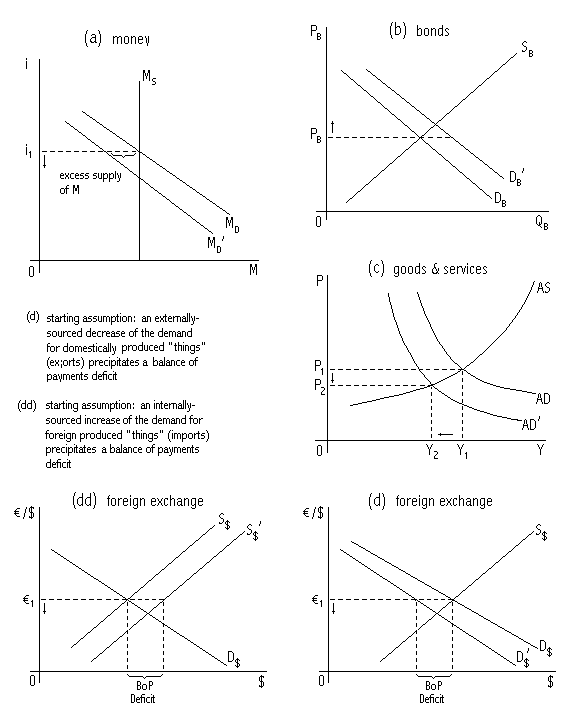
Comments
Post a Comment